China Talks #1: Professor Bai Tongdong
‘A dose of Confucianism can protect the rule of law from populism’
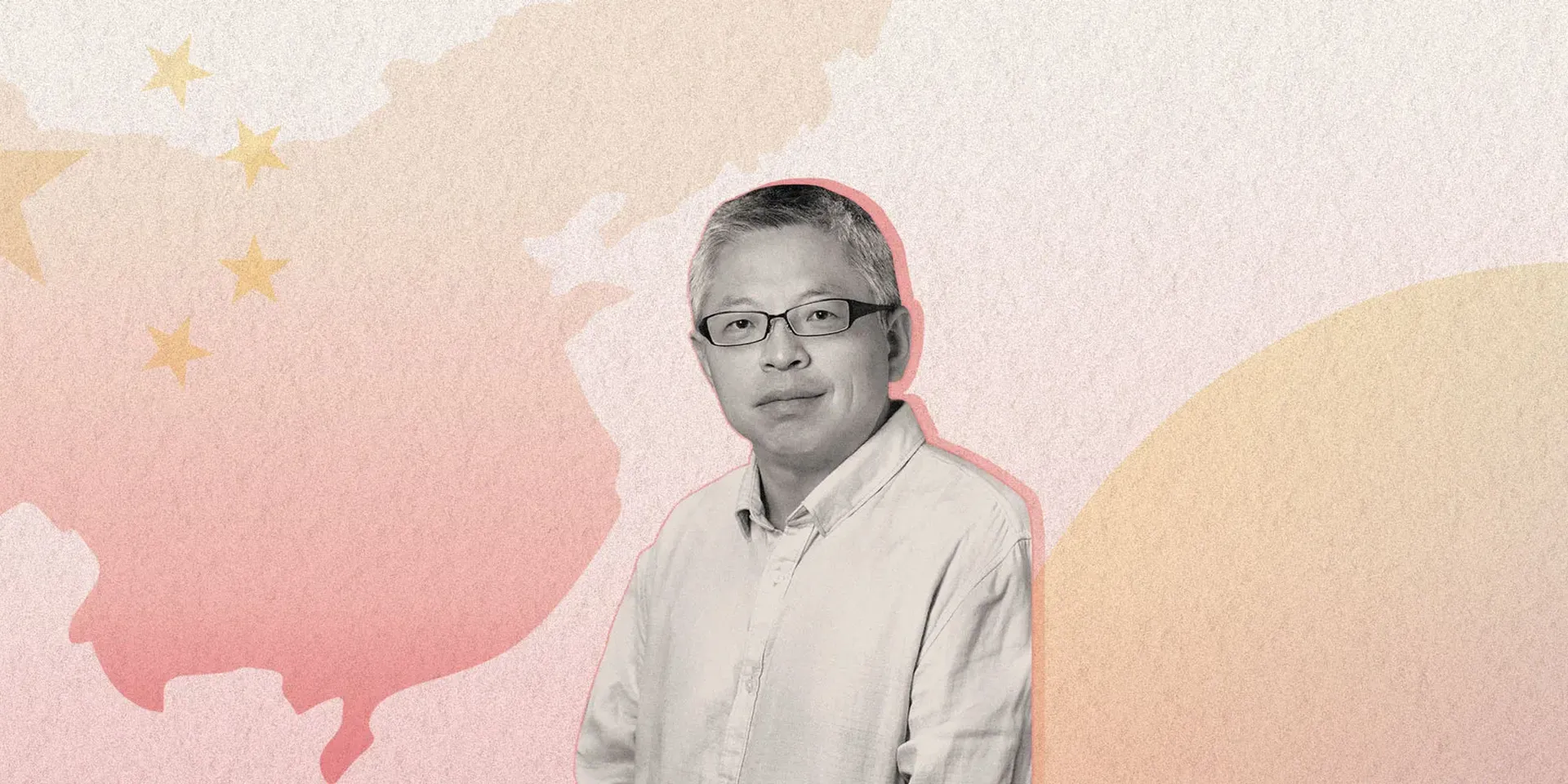
© Bai Tongdong (ontwerp: Justine Corrijn / MO*)
© Bai Tongdong (ontwerp: Justine Corrijn / MO*)
In his work, Professor Bai Tongdong brings together Western political ideas with Chinese philosophy to consider possible alternatives to liberal democracy. In doing so, he advocates a coalition of states that put compassion at the centre to save the world from destruction.
Series: China talks
The post-war world order is upside down and China is increasingly casting itself as an alternative. But what do we really know about that country?
In this series of interviews, MO* contributor John Vandaele explores how the Chinese really think. Episode 1: what can we learn from Confucianism?
This article was translated by kompreno, which provides high-quality, distraction-free journalism in five languages. Partner of the European Press Prize, kompreno curates top stories from 30+ sources across 15 European countries. Join here to support independent journalism.
Bai Tongdong teaches political philosophy at the renowned Fudan University in Shanghai and is also affiliated with New York University. He has often worked in the West and is well versed in the Western philosophical tradition.
Despite – or precisely because of – that experience, in recent years he has focused on the question of whether Confucianism can mean something for the contemporary world. On that subject, he wrote the book Against Political Equality, a title that sounds anything but politically correct.
We start our conversation by noting that many philosophy departments at Western universities hardly pay any attention to Chinese philosophers. Some even believe that they do not really exist.
‘When people ask if there is such a thing as Chinese philosophy, many actually mean: is there such a thing in China that resembles Western philosophy?’ says Tongdong. ‘My answer to that is: yes, there is. But unfortunately, many researchers in Western philosophy departments are still trapped in their own conception of philosophy, a tradition that runs from Plato to today.’
On the other hand, Chinese generally know more about the West and speak Western languages more often than vice versa.
Bai Tongdong: ‘That is a phenomenon of the past 150 years. Before that, we Chinese were at least as arrogant as Westerners today, even if Europeans sometimes had more knowledge of the outside world. So there is nothing special about this Western arrogance, any more than there was about the arrogance of the Chinese before their almost fatal encounter with the West. When you are the producer of everything for two hundred years – or, in China’s case, even a thousand years – you soon start thinking that nothing interesting can come from elsewhere. That’s wrong, but also understandable.’
One Western philosophical streak did prove very influential in China: Marxism. Can you tell us something about that?
Bai Tongdong: ‘Let me give you an answer you can use: my work has nothing to do with Marxism.’
What your work does have to do with is Confucianism. Why is it interesting to explore what that thinking can mean for today’s world?
Bai Tongdong: ‘In 1990, Francis Fukuyama claimed that the search for the ideal form of government has ended because we know the answer: liberal democracy. But over the past two decades, we saw that liberal democracies faced more and more problems. That leads us to look for alternatives.’
Like Confucianism.
Bai Tongdong: ‘In my book, I explain that Confucianism and Taoism arose at a time when the old order was collapsing. People were looking for something new. The old order was – in Western terms – a medieval feudal regime; the new order consisted of much larger empires.’
‘Thinkers like Confucius or Mencius resemble early modern European thinkers. Now if we look to Locke, Montesquieu or Machiavelli for answers, which they wrote when European feudalism was disappearing, we can just as easily read Chinese thinkers, who thought about similar problems.’
One of your conclusions is that Confucianism is not fully compatible with ‘government for, of and by the people’ as American President Abraham Lincoln advocated.
Bai Tongdong: ‘“For the people” is abundantly clear in Confucianism because the leader must provide for the basic needs of the people. Governance "of the people" is already more controversial for Confucianists. You can argue about that.’
Governance by the people, symbolised by universal suffrage, does not correspond to Confucianism, you write. Why is that so?
Bai Tongdong: ‘Those who do not believe that the state should be led by the people establish that people are unequal. The good should lead, the bad should not. This is also Plato’s idea in The Republic: we are born of different metals. Those born of good metals may lead. Others don’t.’
‘Mencius would have said that anyone can become an ideal human being. So in terms of potential, he recognises a form of equality. But in reality, only a few actually manage to realise that potential. If that is so, the state should do everything it can to help people develop their potential as ideal human beings. But as long as not everyone succeeds, according to that reasoning, you should give more say in decision-making processes to those who do succeed.’
Mencius defines the good leader as someone who is able to think of the public interest and not just his own.
Bai Tongdong: ‘Everyone has the potential to become such a leader, but in reality few succeed. Again, it has something inclusive because everyone qualifies.’
Liberal democracy contains two elements. On the one hand, you have democracy, where the people choose the leaders, and on the other, there is liberalism: the limitation of power through the rule of law and the protection of basic rights and freedoms. How does this relate to Confucianism?
Bai Tongdong: ‘These days, we see that the democratic element increasingly threatens the liberal: the rise of right-wing populism threatens the rule of law and freedoms. Just look at the America under Donald Trump.’
‘The two elements are actually in conflict. Then you can ask which of the two you want to preserve. As a philosopher who advocates freedom of speech, I would prefer to preserve freedoms and rights, i.e. the liberal element.’
‘Although Confucianism also contains the liberal element, I recognise that Western political thought has developed it much better. My book is not a rejection of Western values, it just retains the good ideas and tries to improve on worse ideas.’
You make a tantalising proposal in your book: a hybrid bicameral system. At the local level, there could be universal suffrage, but at higher levels, in addition to an elected chamber, there would also be a chamber whose members are selected on the basis of expertise. Such a upper chamber could intervene, for example, when a democratically elected leader claims that climate change is a hoax. How has there been a response to that idea?
Bai Tongdong: ‘I have been defending that idea for more than a decade. I was a fellow at the Harvard Safra Center for Ethics in 2016. When I launched the hybrid bicameral system shortly after Trump’s first election, a colleague said, "Before, I would have found your proposal insane, now I find it less insane." The current situation makes people more open to my proposal. As a result, my book has been received quite positively.’
It often sounds that the dire situation in the world is due to a lack of democracy.
Bai Tongdong: ‘I argue that there is too much political equality. But most Western thinkers think there is not enough democracy, it is true. They say the US, for example, is a plutocracy and oligarchy, that the current problems would not exist with a real democracy.’
China’s current leaders first gain experience as administrators at lower levels and gradually climb up to small and large provinces. If all that goes well, they stand a chance for central government. Is that the kind of governance model you advocate?
Bai Tongdong: ‘No governance system today approaches what I propose, including the current Chinese one. What comes closest is the early American regime, when senators were elected by and from members of state parliaments and not by voters.’
‘Governing locally first before moving on to higher levels is indeed in line with what I propose to select meritocrats. But this should then be done in a rule-of-law framework, with clear procedures dictating how it should be done, rather than through meetings between unknown elites behind closed doors.’
Compassion as the basis of “civilisation”
Mencius and Confucius lived in a large state in which many people lived together without family ties and did not know each other. The question was how to still create connectedness in such a society. Their answer was compassion and humanity: the idea that you cannot remain unmoved when you see a child suffering, for example. So they did not assume that humans think only of their own self-interest.
Bai Tongdong: ‘Thinkers like Adam Smith or the early Enlightenment thinker David Hume also referred to compassion. Nietzsche called compassion a disease of modernity. This confirms my view that China had a kind of political modernity very early on, and that was Mencius’ reason for raising compassion or empathy.’
‘Compassion can provide an answer to the modern phenomenon of a society where ‘‘strangers’’ live together. It provides the basis for civilised interaction with each other, supported by rules and institutions. You are a member of the community if you adopt that civilised way of doing things.’
You call this a ‘thin identity’, compared to nationalist movements that make a cultural or racial connection a condition of being part of the state. Confucianism is little nationalistic: people can sympathise with all other people, not just their "own" people. It does have a hierarchy: first the family, then one’s own state, then other civilised states and only then barbarian states. That hierarchy looks rather rigid today.
Bai Tongdong: ‘You can think that rigid. But from a Confucian perspective, say, concern for the suffering of an unknown old woman is rooted in concern for your own grandmother. Your concern for your compatriots is stronger than that for people who are not officially compatriots. After all, the root must be stronger than the branch. Cosmopolitans claim to like all people equally, but for Confucianists that lacks foundation. As a result, such an attitude is difficult to sustain.’
‘In my book, I give the example of Angela Merkel’s statement "Wir schaffen das". Solidarity with people from migrant backgrounds did not last and eventually turned into the rise of the far-right in Germany. Confucianism therefore seeks a middle ground between nationalism and cosmopolitanism.’
The term ‘Tianxia’ – everything under heaven – is important in Chinese thought. You give it a contemporary interpretation. Your new Tianxia model represents all civilised states, i.e. serving their people, pursuing humane governance and having compassion as a core value.
Bai Tongdong: "I realise that the term ‘‘civilised’’ can be misleading. Western colonial powers once thought local populations were barbaric and so it was okay to kill them. By civilised, I mean something different: having and developing compassion, especially for your own people but secondarily also for others.’
‘Besides that hierarchical form of compassion to connect people, I agree to also use softer things like culture for this. A Chinese person is a compassionate person, but a compassionate Chinese person is not yet a Japanese person. What connects Chinese people are language and culture. That is a soft identity. If a non-Chinese learns the language and behaves like other Chinese, they become one of them.’
‘It is precisely because of this soft identity that China was able to remain China for two thousand years, even though it was repeatedly conquered by nomadic peoples and many people settled there from outside. Chinese identity is much softer than a race-based identity, because you can never become a member of another race.’
‘“Barbaric” then refers to a state that cares little for its own people nor for others. If people starve while those in power invest in nuclear weapons to threaten other countries, then such a state is utterly barbaric. In that case, a government loses its right to sovereignty: when a regime is completely barbaric, other countries may be justified in intervening to save the people and eliminate that government.’
You also define civilisation internationally. The use of force against other states is not civilised unless it serves to free a people from a barbaric regime. Environmental degradation is also uncivilised. For example, when the United States steps out of the climate agreement, you don’t think that shows much civilisation.
Bai Tongdong: ‘No, indeed it doesn’t. Look, before Trump took office, China and the US could possibly form a P2 of two responsible superpowers – a reference to the P5, the five permanent members in the UN Security Council. You could possibly expand that to P3 or P4, adding the EU and Japan. Or why not India and the Asian alliance ASEAN. A kind of federation of states trying to maintain world order.’
Rules without swords are hollow words
You would replace the P5 with an H5, the humane 5.
Bai Tongdong: ‘That’s a nice way of putting it.’
That is very idealistic, but is that stronger than rules-based order and the UN charter that demands respect for territorial integrity.
Bai Tongdong: ‘My biggest reservation about that order is in line with what the English philosopher Thomas Hobbes said: rules without swords are just hollow words. If someone breaks the rules, who enforces them? The UN is toothless. Russia, as a permanent member of the UN Security Council, is invading Ukraine, so the UN can do little. The idea behind my proposal is that power should enforce rules.’
That, then, is the H5.
Bai Tongdong: ‘In today’s world, only states have real power. Instead of hoping for some kind of world government like the UN, the only hope is that whoever is powerful is also responsible.’
And since Trump took office, the idea of powerful states being responsible is no longer feasible?
Bai Tongdong: ‘Indeed.’
In the book, you suggest that China may not be that much better. It does not automatically conform as a civilised state in your modern interpretation of Confucianism.
Bai Tongdong: ‘Indeed, that is what I write.’
Just war according to Confucianism is very similar to Responsibility to Protect, the responsibility to defend the population against its own rulers, which was promoted by the UN in the recent past. Applying that to Gaza, didn’t the world need to intervene there?
Bai Tongdong: ‘According to Confucianism, the Israelis should not wage war in Gaza in revenge for the October 7 attack. For Confucius, war in retaliation is never justified. The idea "we kill 10,000 of you because you killed 1,000 of us" is unacceptable. If you were to say, Hamas is bad for the Israelis and for the Gazans, and we target the war specifically against Hamas fighters, that might be possible according to Confucius. But that is clearly not the case here. We know that Israel uses AI to calculate that they may kill 10 innocents for one Hamas fighter.’
The war killed more than 70,000 people.
Bai Tongdong: ‘‘This is an unjustified war. The curious thing is that those who criticise Israel are often told that Hamas is bad. This is strange: the two can be true at the same time. The same goes for Trump: criticism of Israel is quickly called anti-Semitic. This is absurd, because many Jews are against this very war. So how can that be anti-Semitic?’’
If we agree that this is an inhumane war, what to do? Europe was divided and barely able to impose sanctions.
Bai Tongdong: ‘The simple answer is: you should impose sanctions. Doing nothing is not good for the Israelis either.’
If the H5 fails and Russia and the US undermine the UN charter, what should come next?
Bai Tongdong: ‘The best thing I can do as a philosopher is to suggest alternatives. We need to transcend the opposition between nation-state and cosmopolitanism; there is a third way. That means going against that absolute sovereignty of the nation-state while recognising that only states actually have power. The rules-based order introduced after 1945 was OK because the US was willing to support it. But now they are no longer willing to do so.’
‘Pure cosmopolitanism leads to a backlash. For example: we cannot leave the issue of illegal refugees entirely to right-wingers. Of course we must show compassion, but first and foremost for our own people. That is why we need to find new, creative solutions. If we show that immigration can also have benefits for the host states, it becomes easier for their own people to accept it.’
How do you view Europe?
Bai Tongdong: ‘The EU and other entities can play a supporting role in maintaining some kind of world order. It doesn’t even have to be a global order. If the EU can govern Europe well, it will be a role model that shows that shared prosperity can emerge without war.’
‘ASEAN is also such a role model. If China does more humanitarian work in other countries, there can be a virtuous circle instead of a downward one. Start with H1 and gradually expand to H2 and H3. That is a Confucian idea of how to still work towards a more humane world in these uncertain times.’
This article was previously published in Dutch on March 13. It was translated by kompreno, which provides high-quality, distraction-free journalism in five languages. Partner of the European Press Prize, kompreno curates top stories from 30+ sources across 15 European countries. Join here to support independent journalism.
The translation is AI-assisted. The original article remains the final version. Despite our efforts to ensure accuracy, some nuances of the original text may not be fully reproduced.
Lees ook
Ontvang het beste van MO* rechtstreeks in je mailbox
Schrijf je nu in op onze gratis nieuwsbrieven en wij houden je op de hoogte van wat er gaande is in onze mondialiserende en snel veranderende wereld.
If you are proMO*...
Most of our work is published in Dutch, as a proMO* you will receive mainly Dutch content. That said we are constantly working to improve our translated work. You are always welcome to support us both as a proMO* or by supporting us with a donation. Want to know more? Contact us at promo@mo.be.
You help us grow and ensure that we can spread all our stories for free. You receive MO*Magazine and extra editions four times a year.
You are welcome at our events free of charge and have a chance to win free tickets for concerts, films, festivals and exhibitions.
You can enter into a dialogue with our journalists via a separate Facebook group.
Every month you receive a newsletter with a look behind the scenes.
You follow the authors and topics that interest you and you can keep the best articles for later.
Per month
€4,60
Pay monthly through domiciliation.
Meest gekozen
Per year
€60
Pay annually through domiciliation.
For a year
€65
Pay for one year.
Are you already proMO*
Then log in here