Documentary raises fundamental questions about land grabbing and the rights of indigenous communities.
Director Dandhy Laksono: ‘What is happening in West Papua is pure colonialism’
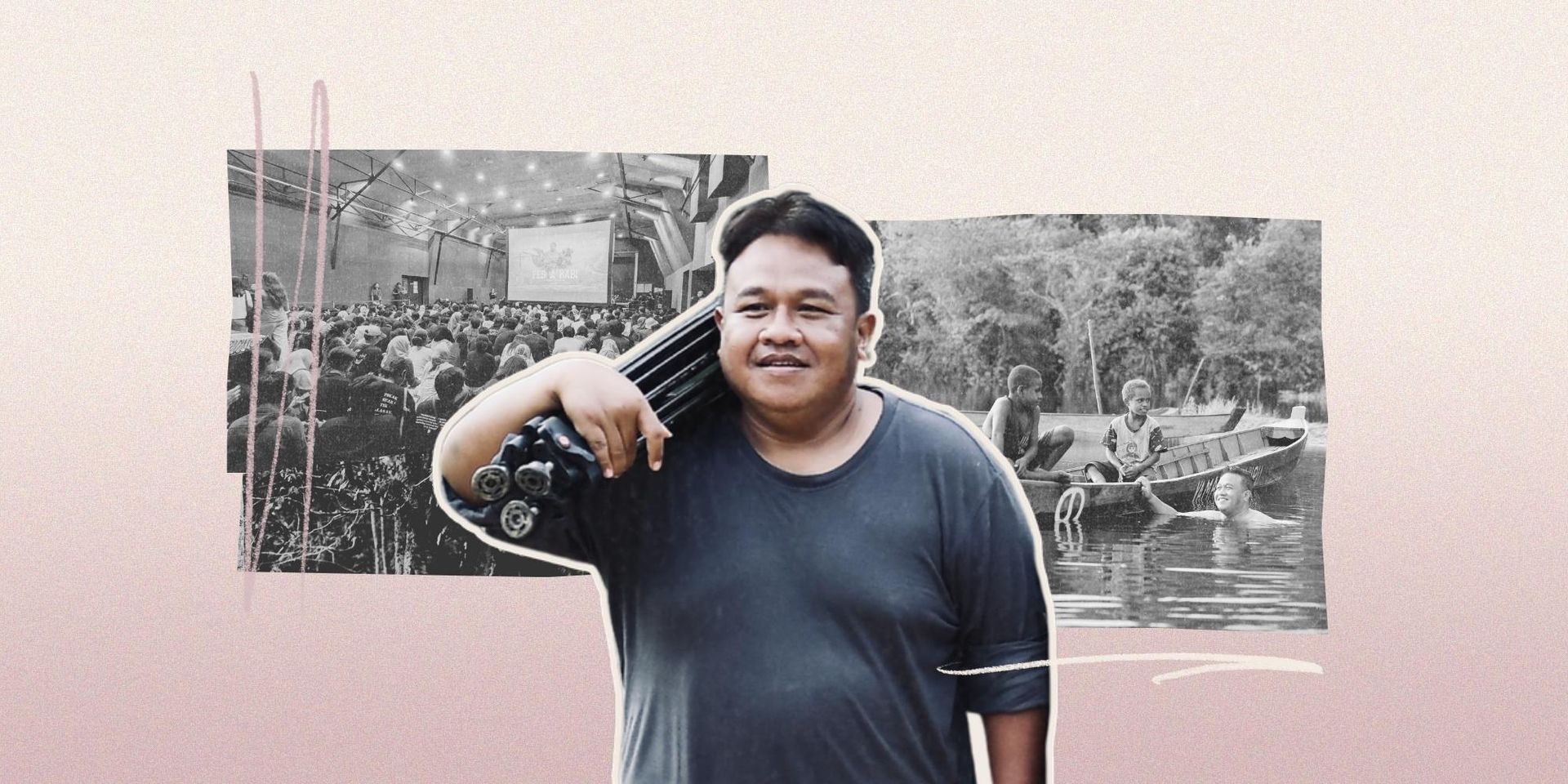
© Dandhy Laksono / Ontwerp: MO*
© Dandhy Laksono / Ontwerp: MO*
22 September 2026 • 14 minutes reading time
The documentary Pesta Babi is causing quite a stir in Indonesia, and even far beyond the country’s borders. Yet co-director Dandhy Laksono remains as determined as ever. ‘The Papuan people deserve our full attention.’
This article was translated by kompreno, which provides high-quality, distraction-free journalism in five languages. Partner of the European Press Prize, kompreno curates top stories from 30+ sources across 15 European countries. Join here to support independent journalism.
This year saw the release of Pesta Babi (literally translated as ‘Pig Festival’), the new documentary by directors Dandhy Laksono and Cypri Paju Dalu. The film is set in Papua, the western, Indonesian part of the island of New Guinea. The region is rich in gold, copper, nickel and gas, but also in vast areas of forest land which, according to the Indonesian government, are suitable for large-scale agriculture.
Since 2020, forests in South Papua have been cleared on a massive scale to make way for food and energy plantations. Pesta Babi highlights the consequences of these ambitious projects whilst raising fundamental questions about land grabbing, militarisation and the rights of indigenous communities. The documentary sparked a national debate in Indonesia that ultimately extends beyond deforestation alone: what is the relationship between the Indonesian state and the people of Papua? And to what extent does the country still bear the scars of its own colonial past?
In the Indonesian capital, Jakarta, we speak to Dandhy Laksono, co-director of the film and one of the country’s best-known investigative journalists and documentary-makers. For more than twenty years, he has been exposing environmental problems, corruption, social inequality and human rights violations throughout the Indonesian archipelago. He gained recognition for, amongst other things, Sexy Killers (2019), about the close ties between the coal industry and the political elite, and Dirty Vote (2024), about the fraudulent use of campaign funds by the then presidential candidate and current president, Prabowo.
Laksono grew up in a small town in East Java during the authoritarian rule of President Suharto. At school, he was taught that Indonesia was a free country, with a democracy and a constitution. But at home, he saw a very different reality. In the early 1990s, his mother sent him to a political rally to record the speech by Guruh Sukarnoputra, the son of the Indonesian independence leader Sukarno. Laksono smuggled a recording device into the venue, whilst his mother waited for him at home.
‘When I got back, she was lying under her pillow, listening to the recording in secret, like a criminal,’ says Laksono. ‘She said: “Even the walls can hear us”. I felt that there was something fundamentally wrong with our system. That fuelled the rebellious spirit within me.’
During the first public screenings, the local authorities and the army tried to intimidate the organisers and visitors. This had the opposite effect, as it only served to draw more attention to Pesta Babi.
Dandhy Laksono: ‘The government is trying to manipulate the population and is selectively using the film’s message. It focuses exclusively on food and energy sovereignty and self-sufficiency. It is not interested in human rights, nor in the rights of the population or their right to determine their own development model and goals.’
‘Unfortunately, that approach has worked to some extent. Many people accuse us of being against the food project and of collaborating with a foreign organisation that wants to import food into Indonesia. However, our film is about much more than food and energy sovereignty. It also addresses West Papua’s right to self-determination and independence, as well as the armed resistance.’
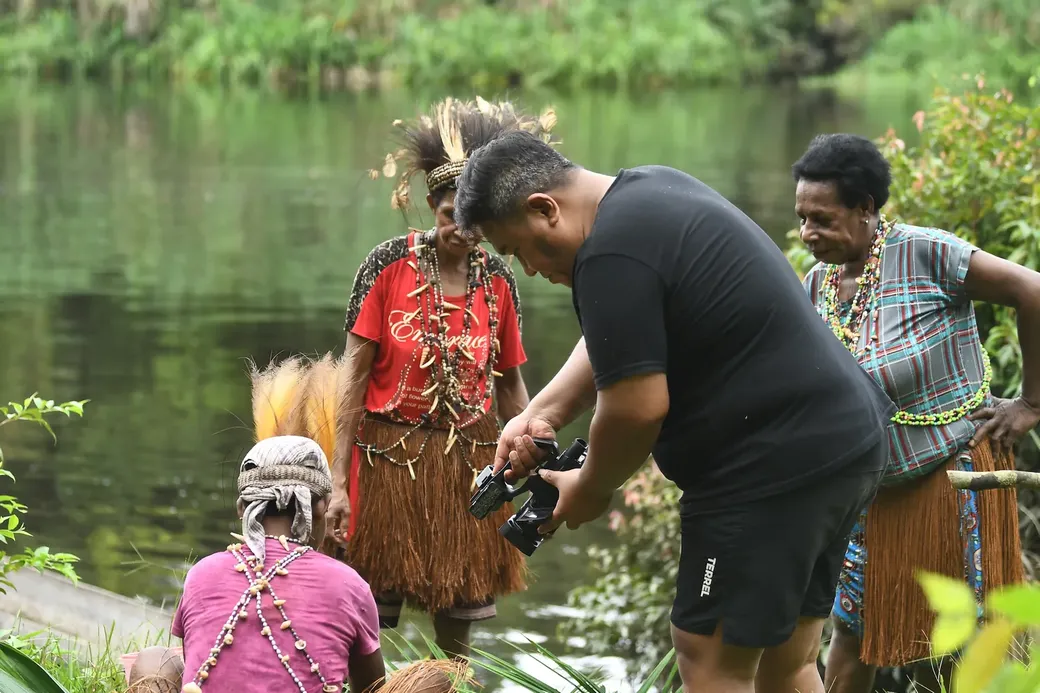
Director Dandhy Laksono during filming for a documentary.
© Dandhy Laksono
West Papua was a Dutch colony until 1962, after which Indonesia took control. Seven years later, that takeover was ratified through a controversial vote, which many Papuans do not recognise as a genuine referendum.
Dandhy Laksono: ‘The southern part of West Papua is known for being very loyal to Indonesia. But I get the impression that the residents are reconsidering or revising their stance. The impact of the large-scale land development projects has given them a new political perspective on Indonesia. I have also met people who fled to Papua New Guinea in the 1980s. Upon their return, they realised that the military operations are extremely drastic and that the large-scale projects are incredibly destructive.’
With your subtitle, ‘Colonialism in our time’, you offer a contemporary interpretation of the concept of ‘colonialism’. Do people understand what you mean by this?
Dandhy Laksono: ‘Yes, I think they do understand that we are now dealing with a local coloniser. At least, that is the reaction they give after watching the film. The subject is very sensitive. In the film, we refer to occupation, to being ruled by an “outsider”. In Indonesian, we also have another term: ‘penjajahan’. That also means colonialism, but it’s more direct and leans towards ‘exploitation’. Our term is neither provocative nor academic. It’s not meant to offend anyone.’
‘Let’s not forget that this is the first time “colonialism” has been used in such a prominent and popular way in a journalistic report on Papua. But the funny thing is that, at many public screenings – or even in reactions on social media – people are more sensitive to the word “pig” in the subtitle (Pesta Babi) than to the term “colonialism”.’
‘But despite the play on words (the “pig festival” also refers to the Indonesian elite who have turned the exploitation of West Papua into a “pig’s mess”, ed.), the documentary does not shy away from reality. What you see in Papua is neo-colonialism. In some debates, people challenge me with questions such as: what is actually happening in West Papua? Is it just a flawed version of development thinking? Or is it genuine colonialism? To me, it’s clear: it goes further than a flawed version of development thinking. It is genuine colonialism.’
Why did you feel it was important for the documentary to be set in Papua?
Dandhy Laksono: ‘I want the spotlight to remain on West Papua, because that is where military operations are taking place, and where there are internally displaced people and refugees. And at the same time, land grabbing is also taking place there. There is no other place in Indonesia where abuses of this kind occur on such a large scale.’
‘When the film went viral, the wider public across the whole of Indonesia made the connection with the broader issues of militarisation, top-down governance and oppression. These issues therefore apply to the whole country, and as a result, the specific focus on West Papua became somewhat overshadowed. The Papuans, however, deserve our full attention and solidarity.’
Food supply
Under the previous president, Joko Widodo, there was a strong emphasis on public infrastructure. The current president, Prabowo, appears to be focusing once again on state-led economic projects, such as food and energy plantations.
Dandhy Laksono: ‘Nationalism is high on the political agenda. Thanks to his military background, Prabowo has learnt that there are two basic needs: food and energy. According to his ideology, people will be happy if you can provide both in abundance. That is the key to keeping the population under control, so that he can do as he pleases. It is his trump card for pursuing a populist agenda. Every dictator will commit to securing food and energy.’
Self-sufficiency in rice, petrol and gas has become an obsession for the political parties. As I travelled through the country, I saw long queues of cars at petrol stations. Is there actually an ‘energy crisis’?
Dandhy Laksono: ‘From time to time, there are queues like that. Certainly following the unrest in the Strait of Hormuz, you’re seeing more people at the pumps again. That’s the paradox: Papua is full of natural resources, but oil and gas are currently a real problem. Let’s not forget that oil and food are linked to the financing of political parties or candidates. Imports are being restricted; companies wishing to import food and energy must apply for a licence, and that has always been a source of corruption and political financing in Indonesia. Control over food and energy means control over your opponent.’
‘Last year, I and several other authors published the book Reset Indonesia, in which we addressed various issues that were also raised by the students during the protests in August and September 2025. It covered food and energy, but also the situation in Papua.’
Gen Z
Do you feel that Gen Z and the students can relate to your documentaries?
Dandhy Laksono: ‘Yes. I am absolutely convinced that I have reached a new audience. This film was screened in secondary schools, and even in primary schools. And after watching it, many teachers tried to spark a discussion. The younger generations often draw parallels with Avatar. For them, this is, as it were, the Indonesian version of that film.’


Are you confident that this generation can contribute to ‘a different’ future for Indonesia?
Dandhy Laksono: ‘Absolutely. Even though their activism mainly takes place online, we can see that they also take to the streets. Last year’s massive demonstrations did not happen by chance. In June 2026, there were a few smaller demonstrations. Let’s not forget, either, that these are taking place against a backdrop of very harsh repression and severe intimidation at universities.’
‘These young people have their own approach and resilience. They also learn from previous generations, for example in terms of leadership and internal organisation. They prefer a decentralised organisational structure. We call these small cells “rimpang”, which refers to plants with strong roots. The students prefer a strong, small structure rather than a “big-tree movement”.’
‘In the 1990s, the protest movement united as one large tree, capable of withstanding a great deal of pressure. But nowadays, “big-tree movements” are made vulnerable by large-scale surveillance. If you remove key figures, the tree will die or change. That is why today’s student groups unite in diversity. Should a number of the small trees disappear, the forest will still stand.’
‘One consequence of this “decentralised” approach is that, according to the Alliance of Independent Journalists, the number of cities joining the demonstrations rose to more than 150 last August. This was unprecedented.’
Isn’t that what a civil rights movement does?
Dandhy Laksono: ‘Yes. But they are also learning that mobilisation alone is not enough. Their struggle must align with other movements, which are likewise well-organised and set out an alternative agenda. We are now at that stage.’
Could you tell us a bit more about that?
Dandhy Laksono: ‘One of the major challenges today is that the opposition in Indonesia is hardly represented at all within formal politics. That is why new initiatives are emerging that seek to bring together critical voices and give them a public face. One such example is the Kabinet Bayangan (Shadow Cabinet, ed.), a new concept in Indonesia that develops alternative policy proposals and critically monitors the government.’
‘I myself am involved with Reset Indonesia, a movement that has put forward 22 alternative political figures. Together, they form a sort of shadow parliament, with representatives from different regions and socio-economic groups. The aim is not to set up a new political party straight away, but to highlight credible alternatives and bring together people who enjoy the public’s trust.’
Are you seeing any concrete results from this yet?
Dandhy Laksono: ‘For the time being, we’re still finding our feet. The recent waves of protests show that there is a great deal of social discontent, but there is still no clear link between these new political initiatives and the broad-based street movements, trade unions, student organisations and other mass organisations. Those movements have the power to mobilise, whilst we are trying to develop alternatives and representation. The challenge is to bring all of that together.’
‘We hope that the next major mobilisation will create a shared momentum, in which social movements and these new political initiatives reinforce one another. This requires trust, shared values and credible figures who not only possess expertise, but can also demonstrate that a different political project is possible. The shadow cabinet therefore consists of young people selected on the basis of their expertise, integrity and commitment to the public interest.’
What was the most significant event during the making of the film?
Dandhy Laksono: ‘The death of my wife. It may sound strange, but somehow I felt freer to devote myself fully to this dangerous project. I was less concerned about the risks, which meant I could venture into a very harsh environment in West Papua without hesitation. I had nothing to lose.’
‘With every new film or story I produce, I feel that something profound changes. I’m not talking about a magical or fundamental change, because ultimately it’s just a film. We can’t fight the system with this film on its own, but it can spark confrontation, foster a network and build collective resilience.’
Kris Vanslambrouck is an Asia expert at 11.11.11. This contribution is independent of the MO* editorial team.
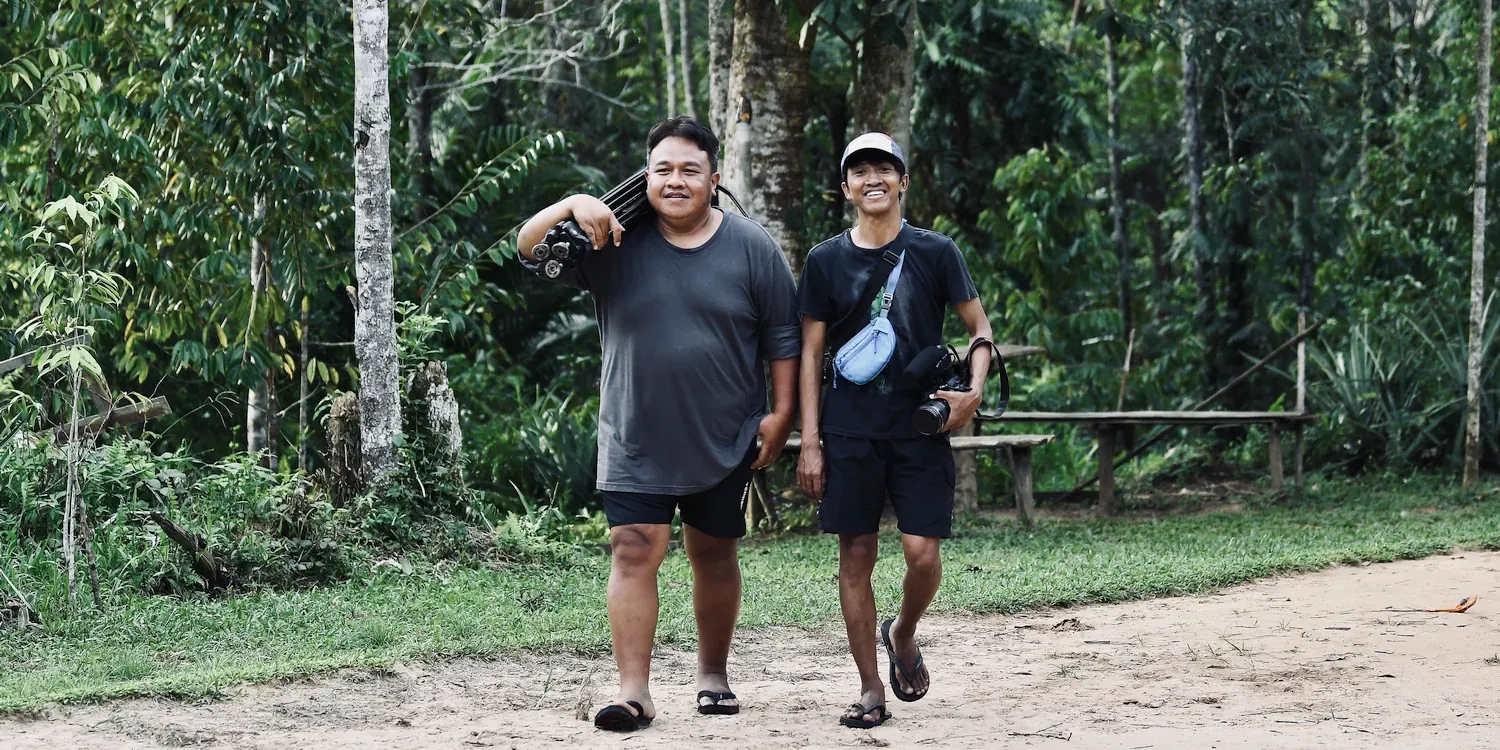
© Dandhy Laksono
This article was originally published in Dutch on september 19.
It was translated from Dutch by kompreno, which provides high-quality, distraction-free journalism in five languages. Partner of the European Press Prize, kompreno curates top stories from 30+ sources across 15 European countries. Join here to support independent journalism.
The translation is AI-assisted. The original article remains the final version. Despite our efforts to ensure accuracy, some nuances of the original text may not be fully reproduced.
If you are proMO*...
Most of our work is published in Dutch, as a proMO* you will receive mainly Dutch content. That said we are constantly working to improve our translated work. You are always welcome to support us both as a proMO* or by supporting us with a donation. Want to know more? Contact us at promo@mo.be.
You help us grow and ensure that we can spread all our stories for free. You receive MO*Magazine and extra editions four times a year.
You are welcome at our events free of charge and have a chance to win free tickets for concerts, films, festivals and exhibitions.
You can enter into a dialogue with our journalists via a separate Facebook group.
Every month you receive a newsletter with a look behind the scenes.
You follow the authors and topics that interest you and you can keep the best articles for later.
Per month
€4,60
Pay monthly through domiciliation.
Meest gekozen
Per year
€60
Pay annually through domiciliation.
For a year
€65
Pay for one year.
Are you already proMO*
Then log in here