When the rich calculate the costs of being poor
Manu Joseph: ‘In India, inequality is a habit’
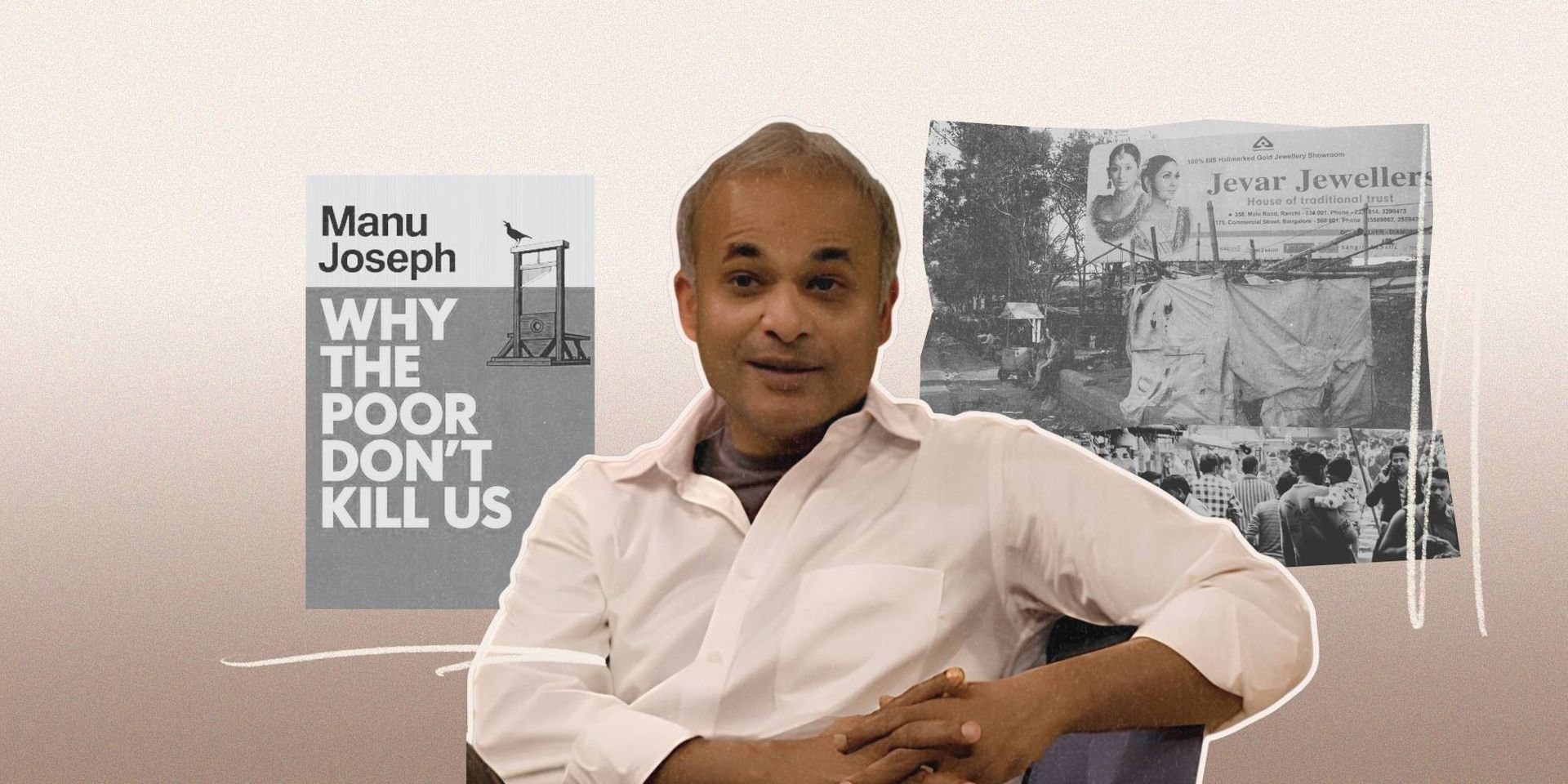
© Martin figura (collage: MO*)
© Martin figura (collage: MO*)

MO* journalist Gie Goris struggled with the cynicism with which Indian author Manu Joseph answers the title question of his book Why the Poor Don’t Kill Us. For a moment, he considered cancelling the planned interview. However, curiosity and professionalism won out over his aversion, though it never became an easy conversation.
Manu Joseph began his writing career as a journalist and was editor-in-chief of Open Magazine until 2014. He has written three successful novels: Serious Men, The Illicit Happiness of Other People and Miss Laila, Armed & Dangerous. Why the Poor Don’t Kill Us was published in mid-2025 and is an extensive essay on the stark realities of inequality in India.
The title already drew my attention, and the blurb on the back cover fuelled my interest further: ‘The poor know how much we spend in a single day, on a single meal, the price of Atlantic salmon and avocados. Why do they tolerate it? Why don’t they crawl out of their catastrophes and finish us off? Why don’t the maids, who squat like frogs beside kitchen sinks, pull out the hair of their conscientious madams who never give them a day off? Why is there peace?’
India is one of the unhappiest nations in the world, Manu Joseph observes. Or at least, that is what he reads in the World Happiness Report 2025, in which India ranks 116th out of 147 countries surveyed. ‘Worse than Ukraine, Iraq and Pakistan,’ he adds. You might well read that as a cynical remark about the value of such lists – because, let’s face it, how is that even possible?
It is the Western Europeans who consider themselves the happiest, he notes. ‘The moral of the story is that the secret to happiness may lie in colonizing, brutalizing and plundering vast regions of the world, so that you can one day raise a financially pampered and socially compassionate population that cycles to work.’ That is a typical passage for Manu Joseph. He points to a valid contradiction – for yes, Western Europe’s prosperity is built on colonisation and plunder – but he completely ignores the social struggles that have led to redistribution and the welfare state. Moreover, he ridicules social compassion and ecological choices. It typifies his view of the world.
‘Poverty is relative,’ writes Joseph at the end of his provocative book. He argues that the poor are quite happy with their family, love, youth, strength, intellect or their gorgeous village. It is envy that threatens that happiness, not poverty. It is inequality and the visibility of what the upper middle class can buy. And it is the self-righteous do-gooders who talk them into victimhood, because that is the only business model they know. Moreover, inequality is not only inevitable, but ‘the poor of Mumbai today have a higher standard of living than the Mughal emperors did in their day.’
I close the book and am on the verge of calling off the interview, but in the end I go against my own resolution. After all, I am a journalist, and so I also want to talk to people with whom I wholeheartedly disagree. I want to know what drives Manu Joseph and what he means, and why his sharp observations make him so cynical about social movements.
All that clamour about equality
If the poor have a problem with the unacceptable inequality, then the rich have a problem with the unpleasant appearance of poverty. That ‘aesthetic problem’, writes Manu Joseph, arises when poor India visibly intrudes into the living spaces of rich India. He quotes a notice from a well-to-do residential complex in Bengaluru: ‘It is difficult to see them (maids) hang out everywhere in the park, amphitheatre and gazebos. Residents can feel uncomfortable when being surrounded by maids everywhere we walk... Cooks, carpenters, plumbers sit on the sofa at the building reception. Most of us have probably stopped sitting on the sofas by now.’
That example shows that it’s not just about class and inequality, but also about caste and hierarchy, yet you don’t mention that.
Manu Joseph: ‘Many maids will instinctively squat or sit on the floor...’
... because they have internalised the hierarchy…
Manu Joseph: ‘... and at the same time, we live in a society where we usually don’t know each other’s caste background. My maid, for example, is from a middle caste and in her village she probably belongs to the middle class. But when she comes into my house, she sits on the floor. The same goes for the driver. If he comes in at all, he sits on the floor too. We don’t see that as a caste issue; it’s a habit.’
You see inequality as a habit?
Manu Joseph: ‘In the same way, it’s not rude not to offer the plumber or the driver a cup of tea. It’s a habit. A custom. Caste plays a less significant role in metropolitan India anyway, unless it concerns marriages. Or when it comes to affirmative action. Then you even get the bizarre effect of people claiming a lower caste status, so that their community too can benefit from the quotas at universities or for government jobs.’
‘If there is one group today that constitutes the universal underclass, it is the Muslims. And that is particularly hard on the Muslim elites, who were used to belonging to the upper echelons of society but are now being discriminated against. Not because Muslims are being excluded by Hindu nationalists, or because it would even be possible to remove them from society, but because they place themselves outside the mainstream. What stands in the way of peaceful coexistence is all this clamour about equality.’
If Muslims were to accept that they are second-class citizens, nothing would stand in the way of what you call peaceful coexistence?
Manu Joseph: ‘Accepting that you are a minority in a country with a clear majority does not have to mean that everything descends into lawlessness. There are incidents, of course. If a Hindu procession passes through the city and a group of Muslims block the road because they are praying, then you get a commotion. But that sorts itself out. Incidentally, communal violence is not a one-way street. Yes, Muslims are victims of it. But at other times, Hindus are the victims. India has human rights, which must be respected. Constitutionally, India is secular, though Indians are not.’
India is ruled by chaos
It surprises me that you speak so easily in sweeping generalisations about how Indians are and think. India has a population of over 1.4 billion people with enormous differences in terms of language, culture, religion and environment. So surely some nuance is called for?
Manu Joseph: ‘I’m not saying that all Indians are the same, but I am talking about the things they share. Rubbish in public spaces is a problem that occurs literally almost everywhere. That connects us more than Bollywood or spirituality, which are actually colonial clichés. Rubbish, and the inability to respect an imposed order. Just try standing in a proper queue and still make it to the counter.’
You describe the display of wealth and its vulgarity as typically Indian. Elsewhere you write that affluent groups such as the Jains from Gujarat or the Syrian Christians from central Kerala do not flaunt their wealth because they attach great value to frugality and moderation. So they are not typically Indian?
Manu Joseph: ‘All communities in India that advocate and practise frugality are wealthy. And yes, if these traders and financiers were to lead India, it would be a more orderly country. But it isn’t. It is a country ruled by chaos. And perhaps you can trace that chaos back to the struggle for independence and the civil disobedience movement, which definitively created a mindset that runs counter to what those in power want or decree. The government says I must put my rubbish in the bin? Then I’ll throw it on the street.’
Peace with stark inequality
You criticise the ‘amateur Indians’, as you call English-speaking and progressive Indians, because they fail to realise their lofty ideals. But what is the alternative: ‘enjoy poverty’, rather than ‘put an end to poverty’?
Manu Joseph: ‘The idea that a society changes through deliberate reforms is a myth created by the left-wing elite. It’s not that Indians don’t want improvements, but they’d prefer them to be free. That limits the possibilities.’
You then advise all young people in their right mind to give up activism and instead go into business and earn money. That would benefit everyone. Does that advice also apply to Hindu nationalist activists?
Manu Joseph: ‘No. I have never equated right-wing political activism with humanitarian activism. Young people who do full-time voluntary work for the Hindu nationalist grassroots movement RSS (Rashtriya Swayamsevak Sangh, National Volunteer Corps; ed.) usually regard that as a form of employment. Perhaps because they have nowhere else to go. On the other side of the political spectrum, most humanities students gravitate towards some form of full-time activism, even if they call it ‘journalism’, or ‘making documentaries’ or ‘art house cinema’. It is them I wish to point the finger at.’
There are an estimated 50,000 volunteers in the RSS. They are anything but aimless teenagers. Yet you seem to accept the intentions and ambitions of the new Hindu nationalist elite at face value without further criticism.
Manu Joseph: ‘No, that’s not true. I don’t like the new elite at all. Perhaps that escapes you because this text is written for Indians, and so I don’t need to explain some of the jokes or sarcastic references.’
When you’re being sarcastic, it’s about the English-speaking and progressive elites who champion sustainability and diversity, eat asparagus and attend literary festivals. You contrast them with the common man, as if he were born right-wing. Anyone who advocates for sustainability or human rights is dismissed as posh and hypocritical, but the new elites, with their tales of the golden Hindu ages, are taken seriously.
Manu Joseph: ‘I try to highlight the consequences of the way the elite view the world and look down on people. It’s different with the new rich, who are culturally much closer to the poor and, among other things, speak the same language. They don’t shift their identity to climb the social ladder. Much of this has to do with symbolism. Every Indian politician is a multimillionaire, but their image is more that of a village leader than of someone belonging to a wealthy elite. This is also reflected in the emergence of a new pop culture. It no longer uses English, but Indian languages.’
‘Perhaps this holds the key to the answer to the book’s title question – why don’t the poor kill us? The poor and the rich increasingly share language, imagination and symbols. So it is not that the left is preoccupied with trivial matters; on the contrary. It is mainly that Indians, and particularly the poor, reserve their political emotions primarily for trivial matters such as religion. The result is a society that seems to have come to terms with the stark inequality.’
Indignation over inequality is hypocritical
In both Miss Laila and The Poor, you compare the 21-storey family tower of Mukesh Ambani – the second-richest man in Asia – in the centre of Mumbai, with the flat of writer Arundhati Roy in Jor Bagh, a green district of Delhi. In each case, Ambani’s obscene wealth comes off better than Roy’s, all things considered, modest home.
Manu Joseph: ‘I’m not really comparing the two, but what particularly bothers me about Arundhati Roy is the hypocrisy. At least capitalists don’t claim to be frugal and modest.’
That makes it very easy for the right and the rich. As long as they’re brazen enough, you can’t hold anything against them.
Manu Joseph: ‘That’s not what I mean. For me, it’s more about a self-righteous attitude of moral superiority, and I find that particularly among left-wing activists and writers. What I really struggle with is the bubble of people who advocate high ethical standards and social commitment, but fail to put any of that into practice in their personal lifestyle or choices. Those who benefit from inequality have no right to denounce that same inequality with a great show of moral indignation.’
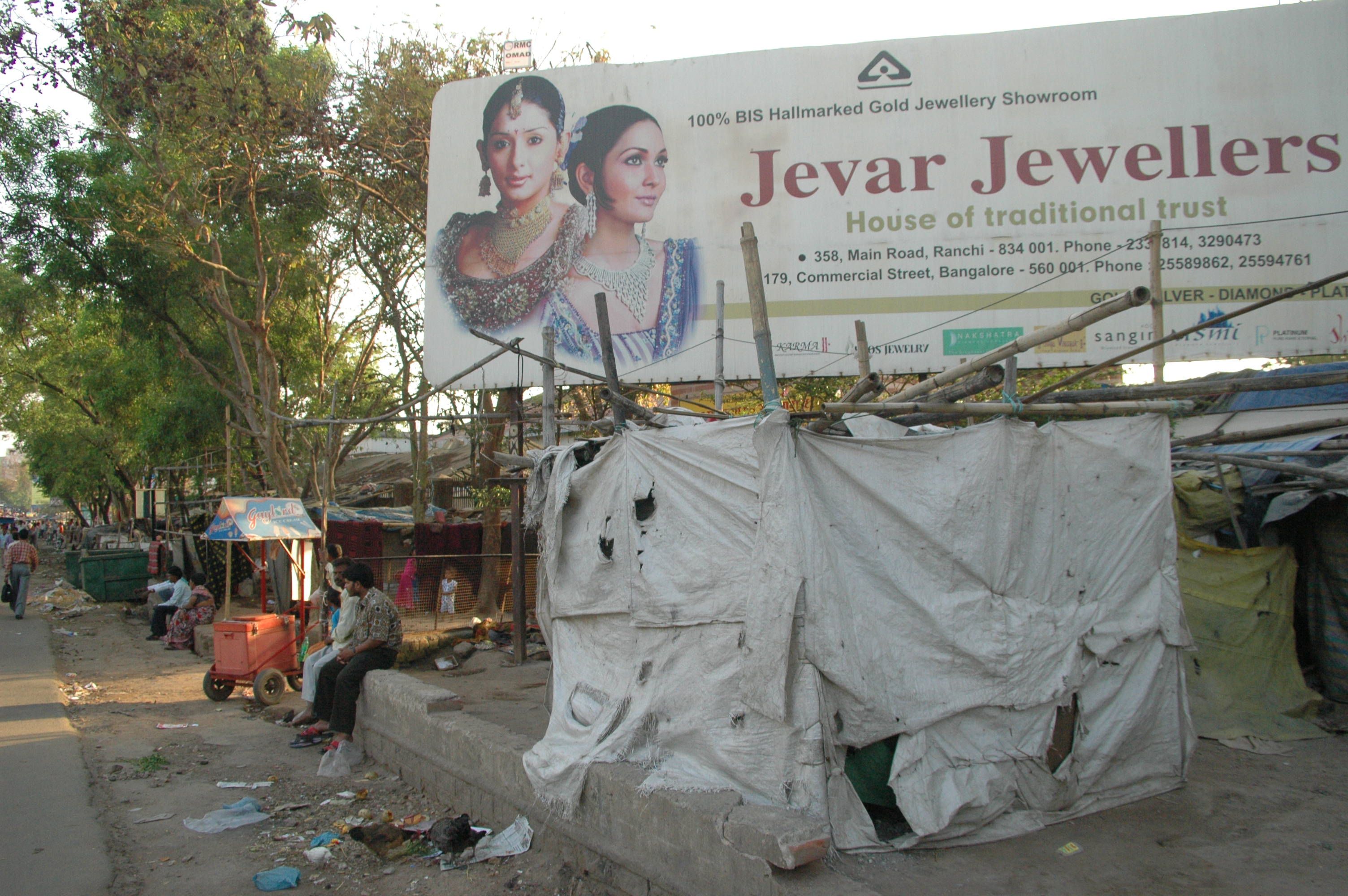
Jewelry advertisement in a slum in Jharkhand, India.
© Gie Goris
You mean that anyone who earns a decent living should shut up about poverty?
Manu Joseph: ‘Ramachandra Guha, one of the leading figures in the secular writers’ circle and a Brahmin by birth, recently lashed out at Brahmin privileges and at the sacred thread that Brahmins wear as a sign of their superior caste. Yet that same Guha sends his children to Harvard to study. That is his sacred thread, but you never hear him mention it. What is wrong with a symbol that signifies your belonging to a caste? Dalits (formerly ‘untouchables’, ed.) also pass on their caste, and the associated professions such as butchers and leatherworkers, from generation to generation. Indignation over inequality in caste is hypocritical if you yourself benefit from inequality in class or wealth.’
In brief: Brahmin parents who believe in the importance of caste and send their children to Harvard are simply living out their cultural identity, but parents who criticise the caste privileges they receive unasked and undoubtedly pass on to their children – are hopelessly hypocritical?
Manu Joseph: ‘Yes. Can a man call himself a feminist whilst accepting a salary that is 25% higher than that of his female colleague? I wouldn’t advise that man to quit his job, but I would advise him to keep quiet about feminism. You can extend that to other forms of privilege. You can’t always refuse them, you aren’t always responsible for them yourself, but they do make your eloquent comments on inequality seem implausible.’
‘In the hierarchy of exclusion, gender ranks higher today than class. So there is more outrage over a poor Uber driver who stares a little too intently at his wealthy passenger’s cleavage than when that rich passenger pays him poorly. The elite not only have a host of privileges, they also have the power to determine which forms of inequality matter and which do not. If you are morally self-righteous whilst simultaneously benefiting from inequality, then you are a hypocrite. That is my basic premise.’
You simply keep building straw men so you can attack them with great fanfare.
Manu Joseph: ‘You might well have a point there. Over the past ten years, I’ve been a bit too quick to get worked up about people and issues, and that hasn’t done my prose any favours either. Another mistake I make is presenting a discussion with one or two specific people as a critique of a movement or a group. If, for example, my criticism of the humanities does not demonstrably apply to the majority of professors in those faculties, then I should have the courage to name those I am targeting.’
A growing sense of injustice
You describe the poor as people who are centuries behind. Not because they are ‘backward’, but because – unlike modern people – they do not expect to have control over their lives.
Manu Joseph: ‘Indeed. When my driver’s child died, he was back at work the very next day. For middle-class people, such a death means the end of the world, but the poor cannot afford that. Which does not mean they love their children any less. The growing prosperity in the country does, however, mean that more people are experiencing the possibility of freedom and control, which increases their sense of injustice.’
‘Once you’ve had a taste of a different life, it becomes difficult to revert to what previously seemed self-evident or inevitable. And that “experience” can also mean witnessing that other, better life. That, too, creates unrest. The more India progresses, the more the sense of deprivation grows.’
Doesn’t that growing sense of injustice lead to the point where the poor simply won’t put up with it any longer?
Manu Joseph: ‘I don’t think so. However, there is an increasing likelihood that the criminals among the poor will feel emboldened. To this day, the chances are slim that, as a reckless criminal from the poor majority, you’ll live past the age of twenty. You don’t survive the diseases, you get fatally injured in a neighbourhood brawl, or you get caught by the police and they’ll sort you out.’
That last point – police brutality – is one of the reasons you cite in the book for the absence of a genuine uprising by the poor. I quote: ‘I wonder how long Indian cities can maintain their relative safety in a changing world where there is more compassion for the poor and the unstable, and where the dangerous among them will survive far longer than before. What will happen if India finds it hard to be as brutal as before in those unseen rooms where parallel justice is dealt?’ You mean it!
Manu Joseph: ‘Look at South Africa. The end of apartheid led to the empowerment of the poor there. But that translated into a marked aversion to brutal police action and support for European human rights standards – to which I am not opposed. However, as a result, the upheaval led to greater scope for violent criminals, rather than a general improvement for the masses of poor people. The consequence is extreme insecurity for everyone. In India, this is still often resolved by summary execution, which is presented as an “encounter” between the police and criminals or other “enemies of the nation”.
Why The Poor Don’t Kill Us by Manu Joseph is published by Aleph Book Company. 266 pp. ISBN 978 93 6523 457 2
Lees meer
Ontvang het beste van MO* rechtstreeks in je mailbox
Schrijf je nu in op onze gratis nieuwsbrieven en wij houden je op de hoogte van wat er gaande is in onze mondialiserende en snel veranderende wereld.
If you are proMO*...
Most of our work is published in Dutch, as a proMO* you will receive mainly Dutch content. That said we are constantly working to improve our translated work. You are always welcome to support us both as a proMO* or by supporting us with a donation. Want to know more? Contact us at promo@mo.be.
You help us grow and ensure that we can spread all our stories for free. You receive MO*Magazine and extra editions four times a year.
You are welcome at our events free of charge and have a chance to win free tickets for concerts, films, festivals and exhibitions.
You can enter into a dialogue with our journalists via a separate Facebook group.
Every month you receive a newsletter with a look behind the scenes.
You follow the authors and topics that interest you and you can keep the best articles for later.
Per month
€4,60
Pay monthly through domiciliation.
Meest gekozen
Per year
€60
Pay annually through domiciliation.
For a year
€65
Pay for one year.
Are you already proMO*
Then log in here