Astute critic of racism in the United States releases new book
Writer Ta-Nehisi Coates: ‘There are not always two sides to a story’
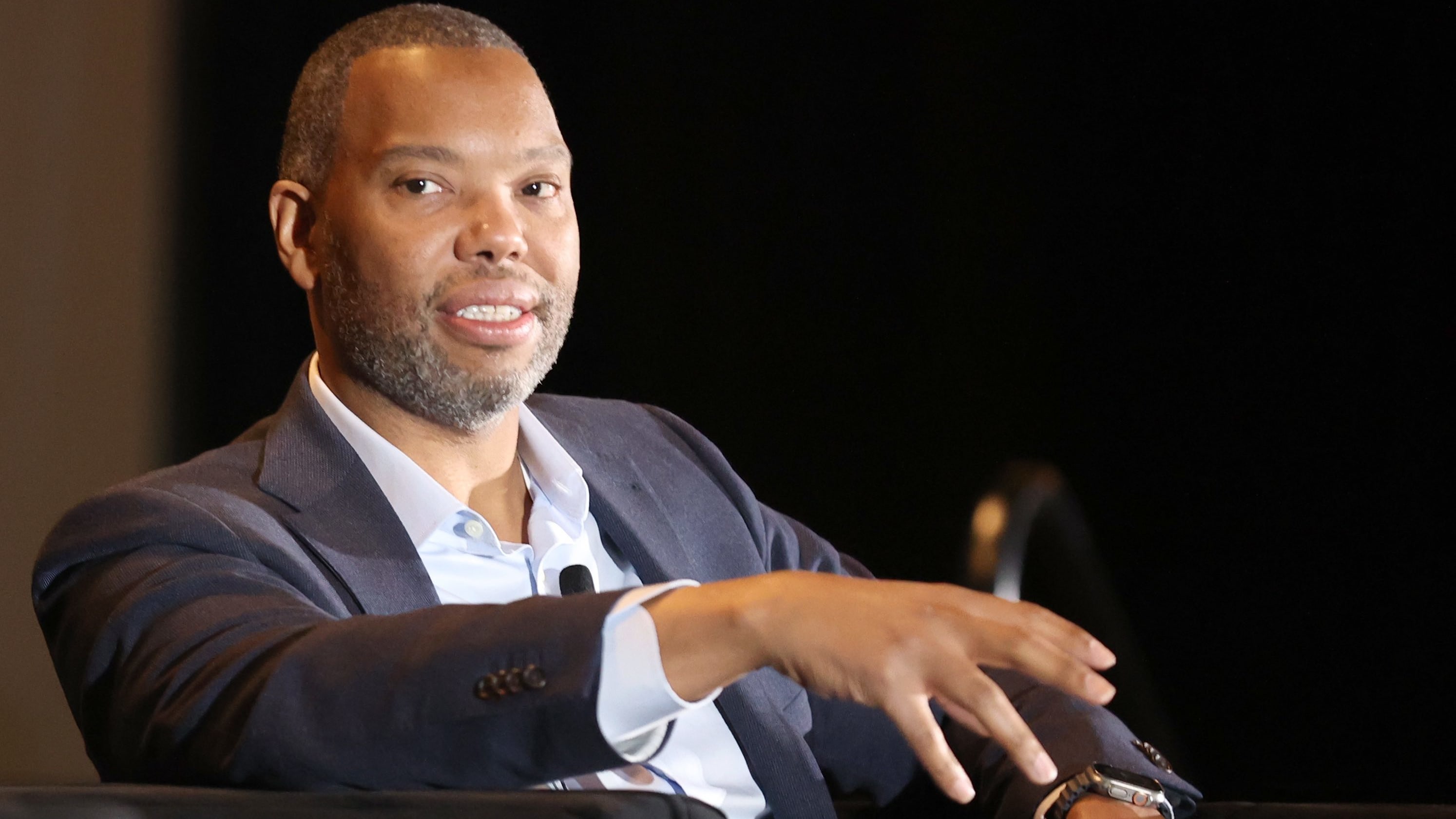
© Peter G. Forest/SipaUSA/Reuters
© Peter G. Forest/SipaUSA/Reuters
23 December 2025 • 14 minutes reading time
For Black American Ta-Nehisi Coates, words are a necessity to explain and make sense of the world that still rests on the foundations of white supremacy. For his new book The Message, he searched Senegal, the United States and Palestine for stories that do the same. He discovered that there are also stories that are not being told, and that not every story has two sides.
This article was translated from Dutch by kompreno, which provides high-quality, distraction-free journalism in five languages. Partner of the European Press Prize, kompreno curates top stories from 30+ sources across 15 European countries. Join here to support independent journalism.
Ta-Nehisi (pronounced Tanahássi) Coates is considered one of the most important and erudite Black voices in the United States. Black, with a capital letter, proud and aware. Very aware of how Black people are still treated today. And, by extension, with all people who are of a colour other than white, who think differently, are grounded differently or adhere to different beliefs from those of white men.
The late Toni Morrison, winner of the Nobel Prize in Literature in 1993, saw in Ta-Nehisi Coates a man who filled the intellectual void that had fallen after the death of James Baldwin. That he occupies intellectual space is as plain as day, and he does not shy away from controversy in the process.
In 2014, he wrote an essay for The Atlantic entitled The Case for Reparations. It highlights the history of slavery, the impact of Jim Crow (racist laws introduced, after the end of the US Civil War in 1865 and the abolition of slavery, in the US South) and racist housing policies. For all that, Coates demands reparations.
In 2015, Prince Jones, a fellow student of Coates at Harvard University, was shot five times in the back by a policeman. Jones was a Black, articulate, well-educated, polite born-again Christian of 25. This dramatic incident prompted Coates to write Between the World and Me, a book addressed to his then 15-year-old son. In it, he recounts his childhood in Baltimore, Maryland, the daily violence he saw there, the rise of the crack epidemic and police brutality.
In June that year, a massacre at a Black church in Charleston, South Carolina, killed nine people. The subsequent clamour from so many Black people for answers was so great that the publisher decided to bring the book to market early.
Between the World and Me was awarded the National Book Award, but is being removed from libraries and banned from classrooms in South Carolina, Colorado and Tennessee today. So writes Ta-Nehisi Coates himself in his new book The Message.
Saving the world
The Message is actually a hefty essay that Coates had promised his students (he has since become a lecturer at Howard University’s Faculty of English) to write two years earlier. That way, they would be able to test what he had taught them about writing with him.
That it took two years for him to fulfil his promise has to do with the fact that Coates has travelled to three conflict zones where narrative, myth and reality intermingle, consciously or unconsciously.
Ta-Nahisi Coates went to the Senegalese capital Dakar, where he went in search of the place where his ancestors, enslaved Africans, were loaded onto ships bound for the Americas. There, he found that that place no longer exists, but stories have developed in its place that claim the right of remembrance of a Glorious Africa.
He moved to Columbia, South Carolina, where his books are thus banned and where stories of white “heroes” who perpetrated the most heinous acts on Blacks are just part of everyday existence. As if the horror never took place.
And Coates also went to Palestine. He did so, for all intents and purposes, before 7 October 2023. There he discovered (once again) the power of words, how they can divide, serve for political gain if twisted and, as it would later turn out, lay the groundwork for genocide.
The lesson (or is it the message?) that Ta-Nahisi Coates wants to give to his students is that a story must be well-written, with attention to rhythm, form and feeling, but above all, content, with the ultimate goal: to do one’s bit to save the world.
‘I wanted to write about the importance of writing in relation to politics and the relationship between the two,’ Coates clarifies. ‘But it is the reader who now has to tell me what the message is. The book no longer belongs to me.’
Education can be a weapon
A common thread throughout the book is education. Necessary for everyone, but the system does not function properly, because not all stories are told there. Here in Belgium, by no means everything was told in school about the atrocities of Leopold II in Congo, and certainly not that he was a mass murderer. In Israel, schoolchildren and students are not taught about the history of Palestine. Is education being used as a weapon?
Ta-Nehisi Coates: ‘Absolutely. If you tell your own story yourself, it can be a weapon. That’s why it is the black tradition of writing in America. And it’s also inherently present in The Message.’
‘The question I ask myself in that is: does the story matter? Does it matter? And it does. It matters a lot to know exactly what Leopold II did. The pictures of those severed hands do matter. If the story didn’t matter, why suppress it? I think it has to do with the fact that those people like to think of themselves as heroes, the white men who brought civilisation to the Congo. They don’t see themselves as villains, instigated by a mass murderer. Nobody wants to go down in history that way.’
‘I saw the film Soundtrack to a coup d’état the other day. Was that a brutal film. Of course, it was also a brutal era. But what I didn’t realise before was how rich and how big Congo actually is. And how the US and Belgium were working together. I also didn’t know that the uranium for our nuclear weapons (which wiped Hiroshima and Nagasaki off the map in 1945, ed.) came from Congo. Which only confirms the importance of education.’
However, you write that you did not have an easy school time. As a black boy, seemingly without a future, was school still a life saver for you? Or was it rather your father who instilled in you a love of reading after all?
Ta-Nehisi Coates: ‘You cannot separate the two. My father and reading are inextricably linked, but being able to go to school was also a lifesaver. It gave my life a purpose, meaning. School pointed out to me that there was an explanation for what I saw in my daily life, why things were the way they were. For me, that was very important.’
Friendly and polite
Do I sum it up correctly when I say that colonisation, racism, politics and education are related and grounded in a white supremacist framework built on lies and a history that never happened?
Ta-Nehisi Coates: ‘Yes.’
In your book, you try to open eyes to that and fill the voids. You do so without anger and hatred, but with kindness, love and empathy, albeit pertinently and without offering your other cheek. Is that balance part of your personality, or did you realise that if you were angry, people would drop out?
Ta-Nehisi Coates: ‘Indeed, I think it has a lot to do with my personality. I don’t like hurting people. Also, my commitment to truth and telling it starts from the point of view that I don’t want to hurt people. I also don’t like to lie. That is dishonourable and disrespectful.’
‘I have no desire to tell you the truth in a rude way. Nor do I feel the need to scold you. I think it is just now much more powerful to be friendly when dealing with people, to be polite, but very direct and firm. In the way I speak, I try to be very open, even if I disagree with my interlocutor.’
Virus
You wrote the book before Trump’s re-election. Would you write another book today?
Ta-Nehisi Coates: ‘That’s a good question. I don’t think so. I wasn’t at all shocked by Trump’s victory either. We had very little chance and the forces against us were very strong. I never told myself that wasn’t the case.’
Did you move to Paris recently because of the political situation?
Ta-Nehisi Coates: ‘(laughs) No, that move actually stemmed directly from my visit to Palestine. This is because I believe that writers should be able to speak a second language. I therefore came to Paris to study.’
‘The political situation obviously plays a role, but I have turned 50 and arrived at a point in my life where I want to learn again. I would have done it too had Kamala Harris won.’
‘But I’m not going to lie to you, life is easier here at the moment than at home. You feel it every day, everywhere. It is totalitarianism in the sense that Trump is wriggling into every aspect of society. And he does so in a very rude way. He is like a virus you cannot escape from. It’s nice to be away from that.’
So why exactly Paris?
Ta-Nehisi Coates: ‘Paris is an incredibly fascinating city, which to some extent you can say about the whole of Europe. There is a very large North African and Sub-Saharan community. Actually, I should just say there is a big African community.’
‘People make a distinction between North Africa and the Africa below it, but in Paris there is no such distinction. You see that in everything, you feel it, and you hear it in the way people speak to each other. The footballer Kylian Mbappé is an excellent example of this. His father is from Cameroon, his mother from Algeria.’
‘I don’t know if everyone feels the same, but as Black in America, you feel like you’re cut off from things, like you’ve lost something. It’s a feeling of not belonging anywhere, not in the US and not in Africa. Now the fact is that the place I came from four, five hundred years ago no longer exists. Moreover, we are not only products of that past place, but also of mass sexual violence. So the US is not even our biological home.’
‘This is not to say that Africa is not important, because it certainly is. But the home I feel, that which gives me strength, the home created globally by people who have a similar experience, I feel in Paris. It’s a transcendent story I haven’t found a name for yet.’
‘I had the same feeling in the Netherlands with the two translators of my book. One of them has a Surinamese father, which means she is also a descendant of a similar experience to that of my people. The other has a father from Los Angeles, literally a Black American.’
‘For me, that translation into Dutch was like rebuilding a spiritual project. To be in a place where you can connect so directly with people who have had a similar experience - it doesn’t necessarily have to be the same, it can be about slavery, about colonisation, about immigration - is intellectually very satisfying as well as giving us enormous strength.’
The frame on Palestine
In Jerusalem, you felt betrayed by fellow journalists because of the way they reported ánd did not tell certain stories. Journalists who give a voice to those who are not heard are often dismissed as activists. You do give Palestinians a voice. Are you an activist?
Ta-Nehisi Coates: ‘I don’t think so. Activists are usually people who want to steer the masses in a certain direction and direct their words accordingly. But the real question I think you are asking is whether journalism is apolitical. Or is journalism connected to politics? Do I have some kind of political mission? To that, the answer is: yes, I do. Moreover, I think people who answer “no” to that question have one anyway.’
‘I thought very hard about that betrayal in Jerusalem and I came to the conclusion that the entanglement between American journalism and the American state is very far-reaching. It’s not something I can prove with hard evidence, but I see it very clearly. So much of the journalism I have read, and even now read, presents Palestine in a way that makes it easier to colonise it. That’s the only way I can explain that betrayal.’
‘Objectivity needs two sides of a story. That is even an implicit condition. But sometimes there are no two sides at all. If a boy is beaten rotten in the street, there are no two sides to that story. If a child is beaten by a parent, there are no two sides. That dichotomy doesn’t always hold true. But if you insist on that convulsively, you favour the abuser because you don’t accurately reflect what is happening.’
‘That frame about Palestine is so strong because it is hard to accept that a group of people are perpetrating existential, genocidal violence. That it didn’t start with the Holocaust, but that things happened many years before that that lead to that violence today and ensure that the only possible solution is to confiscate a piece of land from another group, take away everything they own, and set up an apartheid state there. That is the dark lesson.’
‘The only important principle is that such a thing does not live in the people themselves. There are no ethnic heroes in this story. There are no heroic nations. There is nothing in the structure, blood, or DNA of the Jews that makes them heroes of the West. Nor is there anything in it that makes them villains. The same goes for Christians, Catholics and Black people.’
 This article was translated from Dutch by kompreno, which provides high-quality, distraction-free journalism in five languages. Partner of the European Press Prize, kompreno curates top stories from 30+ sources across 15 European countries. Join here to support independent journalism.
The translation is AI-assisted. The original article remains the final version. Despite our efforts to ensure accuracy, some nuances of the original text may not be fully reproduced.
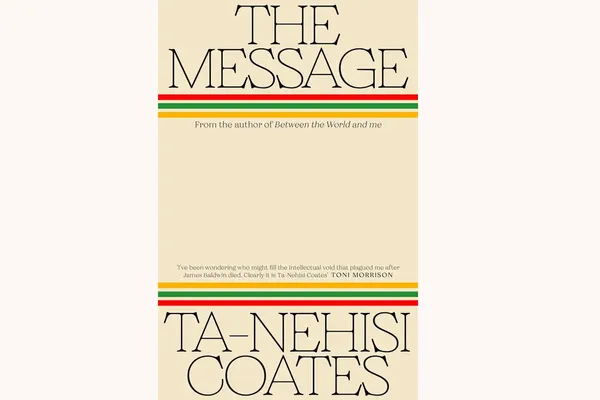
The Message by Ta-Nehisi Coates is published by Hamish Hamilton, 2025. 232 p.
If you are proMO*...
Most of our work is published in Dutch, as a proMO* you will receive mainly Dutch content. That said we are constantly working to improve our translated work. You are always welcome to support us both as a proMO* or by supporting us with a donation. Want to know more? Contact us at promo@mo.be.
You help us grow and ensure that we can spread all our stories for free. You receive MO*Magazine and extra editions four times a year.
You are welcome at our events free of charge and have a chance to win free tickets for concerts, films, festivals and exhibitions.
You can enter into a dialogue with our journalists via a separate Facebook group.
Every month you receive a newsletter with a look behind the scenes.
You follow the authors and topics that interest you and you can keep the best articles for later.
Per month
€4,60
Pay monthly through domiciliation.
Meest gekozen
Per year
€60
Pay annually through domiciliation.
For a year
€65
Pay for one year.
Are you already proMO*
Then log in here