Spanish anthropologist and author Virginia Mendoza
‘We must unite against those who want to monopolise water’
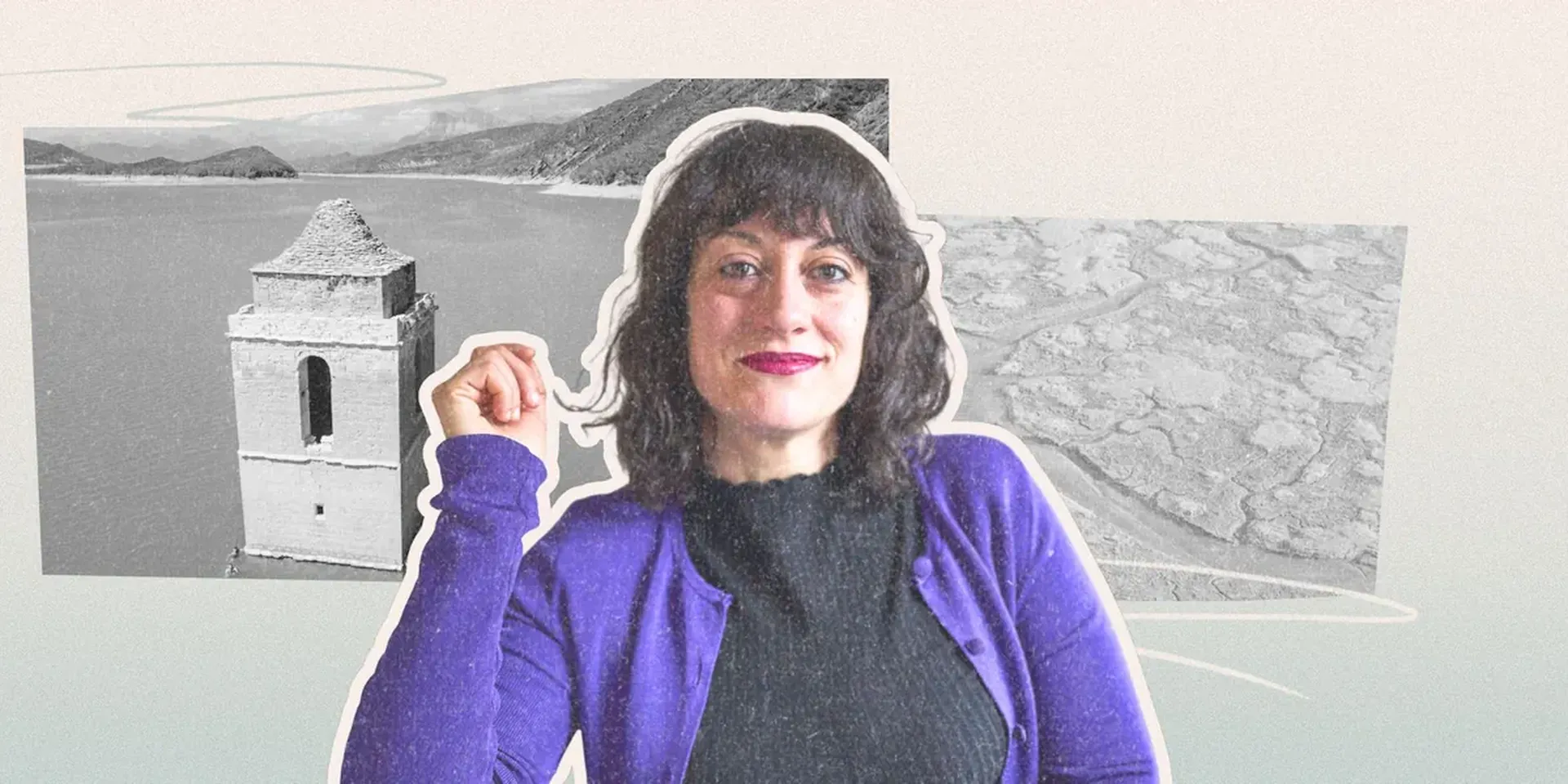
© Alberto R. Roldán / Ontwerp: MO*
© Alberto R. Roldán / Ontwerp: MO*
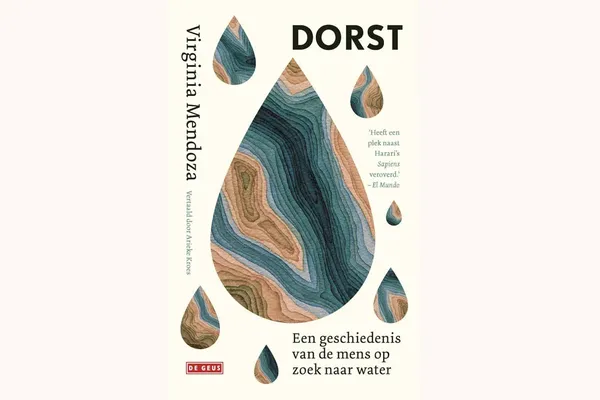
In her book Thirst: A History of Humankind’s Search for Water, Virginia Mendoza wrote about drought as a driving force behind major changes in the evolution of the human species.
This article was translated from Dutch by kompreno, which provides high-quality, distraction-free journalism in five languages. Partner of the European Press Prize, kompreno curates top stories from 30+ sources across 15 European countries. Join here to support independent journalism.
The people were told that it was because the rain had failed to come. That the spring from which the river rose had almost dried up and that this was why the harvests had failed. But then it came to their attention that the maize cobs on a large estate were flourishing. That water could indeed be found there. Citizens protested against this unfair control over water.
A month earlier, riot police had forcibly dragged the inhabitants of a centuries-old village – one that was to be wiped off the map by a reservoir – from their rooftops. They, too, protested against this control over water.
These stories took place in Riaño, in the Cantabrian Mountains, and in Villanueva de la Fuente in Castile-La Mancha, in 1987 – the year Virginia Mendoza was born there – and where, as a child, she became fascinated by both too little and too much water. It led to her non-fiction epic Thirst: A History of Humankind in Search of Water.
Without water, there would be no humans. But also: without drought, there would be no humans. Our ancestors turned out to be best adapted to the droughts of East Africa. They evolved into Homo sapiens.
The rest of history, too, is a story of thirst. Some 2.8 million years after our species began walking upright, drought in East Africa once again became a defining factor. This led to the ‘Out of Africa’ migration. Homo sapiens spread across the planet, began practising agriculture, founded settlements such as Jericho, and eventually built great civilisations between rivers, from the Tigris and Euphrates to the Indus and the Yangtze.
Rethinking ourselves as a species
Mendoza shows that our ability to think as a group, to make collective decisions, has made us more resilient to climate change in the past. Who we are today is the result of how humanity has adapted to this. Why shouldn’t we be able to do that again now? Why don’t we make collective decisions any more today?
‘Because humanity has fallen victim to a crisis which, without fully realising it, it helped to create itself,’ replies Mendoza. ‘Collective decision-making is our survival mechanism. We need it today more than ever, but at the same time it has become more difficult.’
‘The human community used to be much smaller, which made it easier to reach joint decisions. Now, billions of people, spread across the entire planet, need to become aware of the same problem. We must learn to think as a species once again.’
In small communities, people are still capable of thinking collectively, says Mendoza. ‘It’s interesting to see how people cope with disasters. Last year, Spain experienced a nationwide power cut. There was no electricity and no light. People took to the streets, met their neighbours and shared what they had with others.’
‘Drought is not purely a natural phenomenon. Those in power help determine its causes and consequences. And victims can also find solutions.’
‘Whilst writing this book, I discovered that communities which had survived historical droughts were precisely those communities which understood that cooperation was essential.’ That is why Mendoza does not want to lose her faith in Homo sapiens. ‘If I have to choose between a naïve view of humanity – based on trust – and a distrustful one, I choose trust. Until the contrary is scientifically proven.’
‘After conducting interviews with the inhabitants of my village, I broadened my perspective. I turned my attention to other cultures and other eras. I discovered that rain dances serve a similar purpose to the processions in honour of the saints in which my grandmother took part. It is not about the belief that a saint can make it rain, but about sharing fear, about being part of something greater than oneself, about seeking a connection with that, but also with one another.’
According to Mendoza, religion therefore means connection. And the rituals are the collective consciousness that we need. ‘When you realise that we have been sharing in suffering for millennia, it becomes easier to rediscover a collective consciousness,’ she says. ‘And hope.’
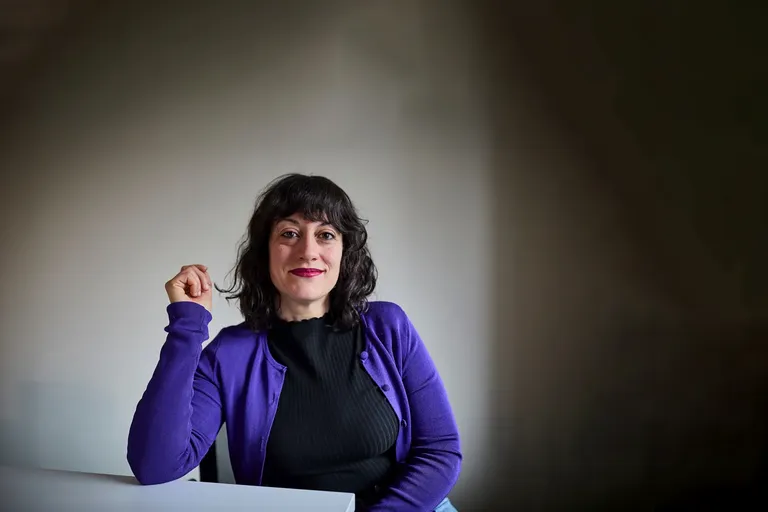
© Alberto R. Roldán
Hope = action
Mendoza is not naïve. She gives just as many examples of drought rituals that were used by those in power to distract the people from the injustice behind the drought. During the grain shortage of 1651 in Córdoba, people realised that it was not the drought that was their greatest enemy, but that the nobility and clergy were hoarding the scarce grain instead of distributing it fairly. This led to bread riots.
‘Clergy organised prayer processions against the drought everywhere to quell the unrest and maintain the status quo,’ says Mendoza. ‘Like opium for the people. But drought is not purely a natural phenomenon. Those in power help determine its causes and consequences. And victims can also find solutions.’
Today, power structures are more complex than they were back then. Control over water and other resources forms part of a broader economic system on which we depend. ‘We will therefore have to unite against those who seek to monopolise or manipulate control over water,’ says Mendoza.
To achieve this, she argues, we must return to the origins of humankind as a species, millions of years ago. A historical awareness of what our relationship with water was like back then is the essential starting point for a new collective consciousness that we need today. From that consciousness, ‘rational hope’ can then emerge.
‘That rational hope is not a form of magical thinking in which a saviour appears to set everything right,’ explains Mendoza, ‘but a belief in our own actions. Throughout history, hope has been important because it spurred people to act and led them to control water, which made their lives easier.’
‘A sedentary way of life meant, apart from no longer having to wander, a shift to a way of thinking that has brought us to where we are today, with all the problems that go with it. We began to believe that we no longer had to adapt to nature, but that nature had to adapt to us.’
That shift in thinking dates back to the beginning of the Neolithic period, around 12,000 years ago, but went into overdrive during the Industrial Revolution. Today, that mindset is deeply ingrained in our culture.
‘Perhaps we should learn from the hunter-gatherers who still exist, or from the indigenous peoples who have adapted well to nature. Modern humans have ended up in a spiral where ever more needs are being created. We try to control nature, but this only makes us more vulnerable. Are we really that much better than those indigenous peoples?’
Who benefits from this?
By controlling nature, you project power. During General Franco’s fascist dictatorship in Spain, the construction of dams became a symbol of progress and state power. Socialism, too, promised prosperity through them.
‘Many Spanish dams were neither necessary nor proportionate,’ says Mendoza. ‘A large proportion of the water from the reservoirs that swallowed up villages in Aragón went to industry in Barcelona, to projects presented as being in the public interest. The real questions, therefore, are: where does that energy go? Who benefits from it? What do you sacrifice for it? And for what purpose?’
‘On television, people saw propaganda. Ribbons were cut at celebrations marking major infrastructure projects. But nobody spoke of the people who were forcibly driven from their homes. Near where I live, there was a village where, one night, the water began to rise whilst the people were asleep. Someone told me how, at three o’clock in the morning, he had to carry a sick woman’s bed out onto a balcony.’
‘We owe a debt to the people who were forced to leave their homes, to those who saw their family graves disappear beneath the water. Sometimes the remains were moved to a new cemetery, but often not even that happened. I cannot imagine how painful that must have been.’
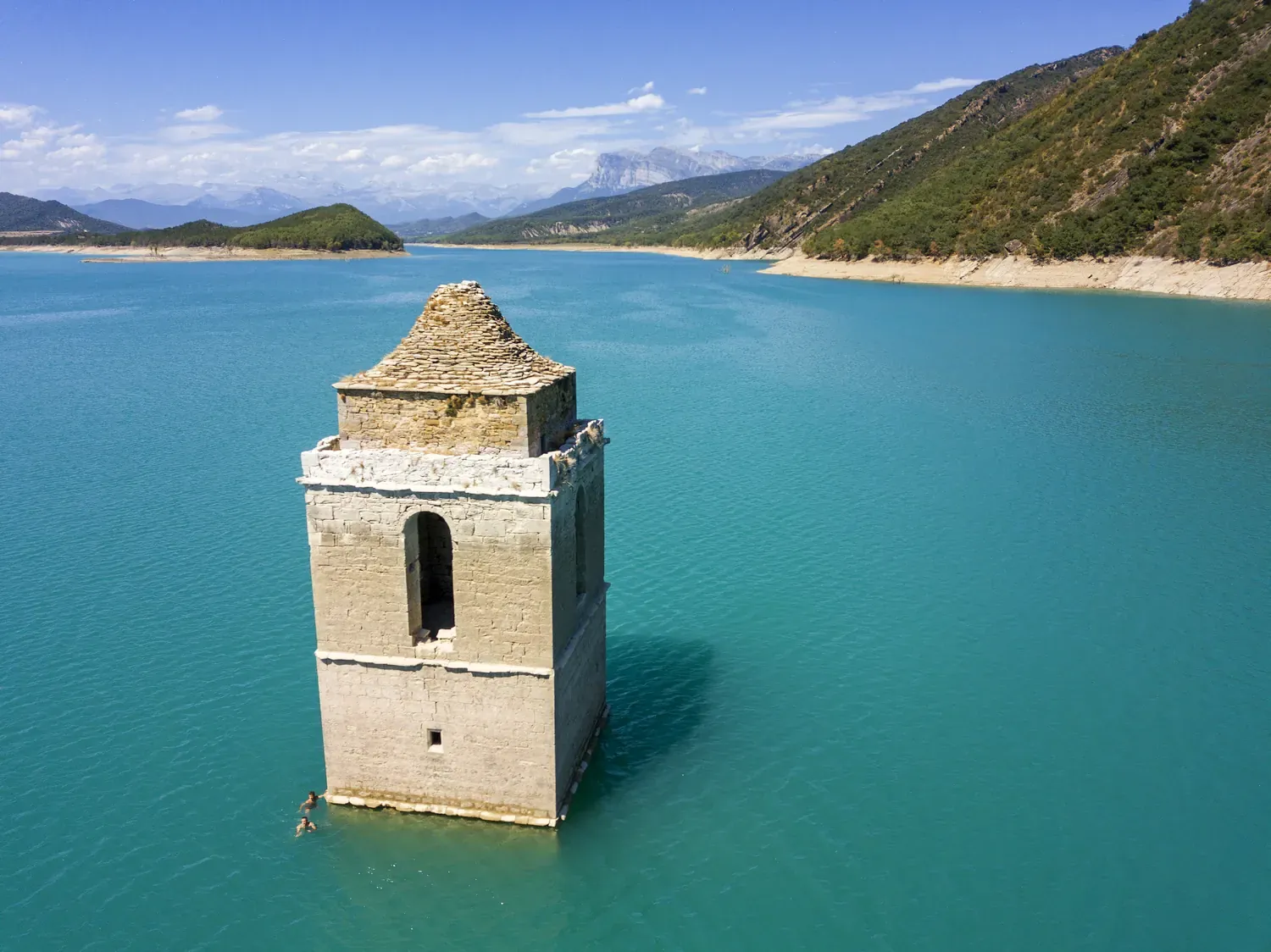
Mediano, one of the villages in the Spanish region of Aragon that were submerged due to the construction of dams.
© Sergi Reboredo/ZUMA Press Wire
Climate migrants and genocide
Long before they were driven out by an excess of water, people migrated because of a shortage of it. And this age-old reality is also becoming our new reality. According to UNESCO, over the past ten years more than 260 million people have been forced to migrate as a result of climate disasters. Drought will become the main cause of a further increase in that migration.
‘In Spain, 60 per cent of people in their twenties want to leave for another country. Many are actually fleeing the consequences of global warming. Southern Spain could become a climatic wasteland where nobody can live anymore. I know that one day I’ll have to move north myself.’
Mendoza recalls the time she worked on the land with her grandfather and saw how people broke open rocks to find water for their crops. At the same time, those people lived with the realisation that one day they would have to leave. ‘When I say that my dream is to have a country house where my ancestors lived, my family reply: “You can’t live there. There’s no water.” Perhaps I’m already a sort of climate refugee.’
‘Humanity is what it is thanks to scarcity and challenges. Scarcity and inventiveness go hand in hand’
According to the archives, a relative of the Mendoza family was already living in the village of Villanueva de la Fuente at the beginning of the seventeenth century. ‘My great-grandfather was the first to leave the village, and my great-uncle was executed there after the Spanish Civil War because of his political views. In his last letter, just before his death, he wrote to his wife that if the drought continued to plague her, she should not hesitate to leave. It was a period of extreme drought.’
Climate migration has always been a solution, an adaptation strategy to climate change that laid the foundations for human civilisations. Without climate refugees, the Sumerian city-states and Ancient Egypt would never have existed.
But Mendoza also points to groups who migrated due to drought and who, upon reaching their new destination – just like most migrants – were viewed as a threat. Or as an opportunity. Not to improve our civilisation, but to exploit them as a source of cheap labour.
Mendoza refers to The Grapes of Wrath, John Steinbeck’s 1939 masterpiece about the Dust Bowl, a period of massive dust storms in Oklahoma. According to a US government commission in 1936, these dust storms were not only the result of drought, but also of years of overexploitation of the soil.
Opportunists seized their chance. The drought drove people from their land, whilst creditors fleeced them even further. ‘Steinbeck’s reports show how migrants were promised a paradise, with jobs, fertile land and opportunities. But upon arrival, they were brutally exploited. Those in power often take advantage of those who are vulnerable and afraid. They turn them into enemies whilst profiting from their labour. These patterns keep repeating themselves.’
‘In times like ours, with multiple crises occurring simultaneously, it is very easy for those in power to single out a group as the culprit,’ says Mendoza. ‘Ordinary people say terrifying things about Muslims; they’re obsessed with a particular group. That’s how genocides begin. Time and time again. Jews were also singled out as a group. The pattern remains the same; only the name of the targeted group changes.’
Just like climate change, genocide does not begin at a specific moment. That is why the process leading up to it is so important. ‘It remains striking how humanity, despite its long history, still finds it difficult to recognise such patterns. Not that I’m writing anything entirely new in my book, but because people learn slowly, we must keep repeating certain stories and placing them within a broad historical perspective.’
Scarcity
We must also keep reiterating that we are heading into a period of water scarcity. ‘Humanity is what it is thanks to scarcity and challenges. Scarcity and inventiveness go hand in hand,’ explains Mendoza. ‘Throughout history, humankind has learnt to appreciate what it does not have, or what is lacking. Because of today’s abundance, we have lost the connection with the scarcity that shaped us.’
‘We have reached the point where we can no longer completely avoid droughts. Yet we continue to use water as if we have forgotten what is going on. Not only us, but also those in power – the people who can take action in good time – tend to forget. We forget history and find it difficult to think about the future. That is why we must keep repeating these lessons.’
This article was originally published in Dutch on september 5.
It was translated from Dutch by kompreno, which provides high-quality, distraction-free journalism in five languages. Partner of the European Press Prize, kompreno curates top stories from 30+ sources across 15 European countries. Join here to support independent journalism.
The translation is AI-assisted. The original article remains the final version. Despite our efforts to ensure accuracy, some nuances of the original text may not be fully reproduced.
If you are proMO*...
Most of our work is published in Dutch, as a proMO* you will receive mainly Dutch content. That said we are constantly working to improve our translated work. You are always welcome to support us both as a proMO* or by supporting us with a donation. Want to know more? Contact us at promo@mo.be.
You help us grow and ensure that we can spread all our stories for free. You receive MO*Magazine and extra editions four times a year.
You are welcome at our events free of charge and have a chance to win free tickets for concerts, films, festivals and exhibitions.
You can enter into a dialogue with our journalists via a separate Facebook group.
Every month you receive a newsletter with a look behind the scenes.
You follow the authors and topics that interest you and you can keep the best articles for later.
Per month
€4,60
Pay monthly through domiciliation.
Meest gekozen
Per year
€60
Pay annually through domiciliation.
For a year
€65
Pay for one year.
Are you already proMO*
Then log in here