Rivers as Ticking Time Bombs in South Asia
“We’d rather die in a war than from a lack of water”
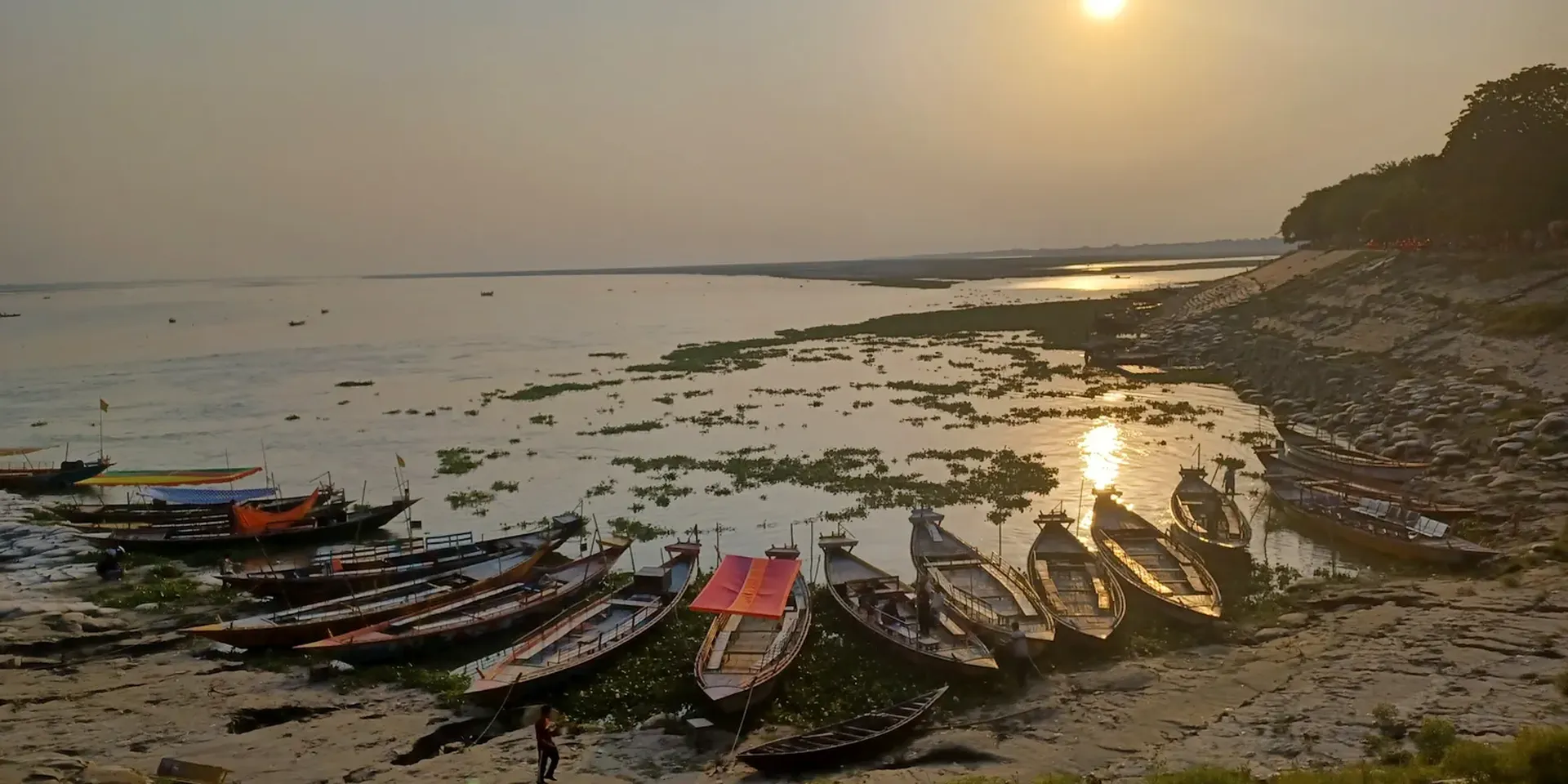
The Ganges, just across the Indian border in Rajshahi, Bangladesh.
© Gie Goris
The Ganges, just across the Indian border in Rajshahi, Bangladesh.
© Gie Goris

Water is the source of life, but the combination of growing water needs and rising nationalism is creating dangerous tensions between Pakistan, India, and Bangladesh. Water is gradually turning explosive in the region.
The Indus Water Treaty (IWT) is an agreement that divides the water of the Indus River basin between India and Pakistan. It was signed in 1960 after eight years of negotiations. That in itself was a success, as the two neighboring countries had been at war with each other since 1947. Both countries lay claim to the northern region of Jammu and Kashmir, and both occupy part of it. For years, the treaty was hailed as a model for managing transboundary river basins around the world.
The most striking aspect of the IWT is that it applies a seemingly simple division of the Indus River basin. The three eastern rivers are for India’s use, while the three western rivers (including the Indus itself) go to Pakistan.
That division seems even, but in terms of water volume, about 80 percent of the water from the Indus basin goes to Pakistan, and 20 percent goes to India.
That, in turn, seems more unequal than it actually is. The Indus Basin is the only river basin that feeds and irrigates the entire Pakistani agricultural region between the far north and the delta on the Arabian Sea, whereas India has several large river basins, including the Ganges and Brahmaputra basins.
Before 1947, India is estimated to have used no more than 10 percent of the Indus Basin’s water. Furthermore, the Indus rivers flow in the far north of India, where there is relatively little agriculture, or where massive infrastructure projects are required to capture the river water and divert it to arid agricultural areas elsewhere.
After four days of escalating violence, a ceasefire was agreed upon. This came as a great relief to the rest of the world, as both India and Pakistan possess nuclear weapons.
In addition, the IWT established institutional mechanisms for exchanging information and addressing any disagreements or conflicts of interest. These were worked out in minute detail, resulting in the seven technical and legal annexes taking up three times as much space as the treaty’s twelve actual articles.
In any case, it is a treaty between two arch-enemies, but it did hold up during the wars between India and Pakistan in 1965, 1971, and 1999, as well as during periods of escalating tensions between and after those wars.
© Studio Verho
The Enemy’s Fields
Until 2025. On April 25 of that year, a deadly attack took place in the Indian-controlled part of Kashmir. The Indian government immediately attributed it to terrorist organizations allegedly operating with the support or connivance of the Pakistani government.
Cooperation with such a country is impossible, the Indian government concluded. It therefore suspended the Indus Waters Treaty “until Pakistan convincingly and irrevocably puts an end to cross-border terrorism.”
A few days later, India also bombed various targets in different parts of Pakistan, to which the Pakistani military responded with equivalent military force. After four days of escalating violence, a ceasefire was agreed upon. This came as a great relief to the rest of the world, as both India and Pakistan possess nuclear weapons.
“India has made it clear that blood and water cannot flow at the same time,” Narendra Modi thundered on August 15, 2025, during the annual Independence Day speech. “The people of this country now realize how unjust and one-sided the Indus Water Treaty was. The waters of rivers that originate in India irrigate the enemy’s fields, while our soil and our farmers remain parched. For seven decades, this treaty has caused unimaginable losses. From now on, the water that belongs to India will be used exclusively for India and India’s farmers.”
Between mid-August of last year and the beginning of this summer, Modi would return to the subject of the IWT and its suspension in at least eighty other speeches.
No Water, No Life
“Marsoon marsoon, Sindhu na desoon.” “We will die, we will die, but we will never give up the Indus.” Thousands of protesters chanted this slogan on July 12 in cities across the Pakistani province of Sindh. All the speeches emphasized that without the water of the Indus, life in Pakistan is impossible.
The immediate trigger for that political storm was the statement on June 11 by India’s Minister of Water, C.R. Patil, in which he said that India would do everything in its power to prevent even a single drop of water from flowing from India to neighboring Pakistan.
The gravity of that threat to Pakistan was succinctly summarized during an international conference in Islamabad on June 30: “ Since the lives and livelihoods of more than 240 million people depend on the Indus Basin, since more than 80 percent of arable land depends on this water, and since agriculture accounts for nearly a quarter of the gross national product and nearly a third of employment, insecurity regarding water supply is tantamount to national insecurity for us. ’
Foreign Minister Mohammad Ishaq Dar also made this position very clear during yet another international conference in Islamabad on August 28:
“The Indus Basin is the lifeline of 250 million Pakistanis. Our agriculture, food security, energy production, livelihoods, and economic development are deeply dependent on the water of the Indus river system. Water security is therefore inextricably linked to economic security, food security, and, ultimately, national security for Pakistan… Any attempt to deprive Pakistan of the Indus water rightfully allocated to it under the IWT will have profound consequences for regional peace and security…’
Water Control
In India, criticism of the IWT had already been growing louder in the years leading up to 2025, and since the unilateral suspension of the treaty, a growing number of Pakistani commentators have also been calling for a revision of the agreements regarding Indus water.
Both India and Pakistan want more water from the Indus Basin. After all, the rapidly growing populations of both countries must be fed and quenched, their bursting cities must be supplied with electricity and tap water, and the increasingly unpredictable monsoon rains must be better collected and buffered. So it’s not just about volume, but also about control.
The political uproar in Pakistan over India’s “suspension” of the treaty therefore had less to do with the now-familiar rhetoric and nationalistic grandstanding, and more to do with the practical steps the Indian government is taking to carry out its threat. In particular, there is one project causing great unease in Pakistan: a tunnel designed to divert river water from the Chenab to the Beas.
“The way India is weaponizing river water is a form of collective punishment.”Khurram Dastgir Khan, voormalig Pakistaanse minister van Buitenlandse Zaken en Energie
The Chenab is a “western” river and the Beas an “eastern” one. This means that the planned tunnel will divert river water—which, according to the Indus Water Treaty, belongs to Pakistan—to a river intended for Indian use. Furthermore, the project calls for the diverted Chenab water to be channeled onward toward Rajasthan, Haryana, and Indian Punjab before it reaches the Pakistani border.
This is no minor detail: water from the Chenab is the primary source of irrigation for Pakistani Punjab, which is the country’s breadbasket.
In a detailed explainer, Shekhar Gupta, editor-in-chief of the Indian news site ThePrint, argues that the tunnel’s capacity is smaller than the amount of Chenab water the IWT allocates for Indian use. So, he says, it is not so much about drying up Pakistan as it is about introducing a new principle: the transfer of water from the “Pakistani” basin to the “Indian” basin.
But Pakistan fears that once this principle is established, the door will be open to more such projects – especially now that all channels of dialogue have been suspended. If Indian ministers or Prime Minister Modi then add fiery threats to the mix, it’s no surprise that Islamabad is also resorting to strong rhetoric.
At the June 30 conference in Islamabad, Khurram Dastgir Khan, former Pakistani Minister of Foreign Affairs and Minister of Energy, stated that “the way India is weaponizing river water is a form of collective punishment, which is prohibited under the Geneva Conventions. Moreover, in light of a looming mass famine, it could constitute a crime against humanity under the Rome Statute of the International Criminal Court.”
He concluded his remarks assertively and menacingly: “Pakistan will protect its rivers. We will fight India’s attempt at hydro-hegemony. We seek peace, but we will wage this war if it is forced upon us.”
Water as a Weapon
“If this conflict is further escalated, both the government and the military will come under pressure from public opinion to act and take the law into their own hands,” I noted during a conversation in Islamabad with a quartet of experts, seasoned veterans of transboundary river policy, but anything but hawks or ultranationalists.
“The sentiment in Pakistan is that we’d rather die in a war with India than from a lack of water.” In other words: “Marsoon marsoon, Sindhu na desoon.”
As if to prove that last point, Ahmad Bilal Soofi, a lawyer at the Supreme Court in Islamabad, wrote an op-ed in early July for the Pakistani quality newspaper Dawn. In it, he argues that Pakistan, based on international conventions, has the right to attack Indian water infrastructure if it is part of a plan to deny Pakistan its right to water and agriculture. The arguments for limited and targeted military action against the Chenab Tunnel Project are on the table, but for now, they are not making an impression on Delhi.
“The Ganges water is of great importance for agriculture in the Bengal lowlands as well as for the delta, which is already receiving too little water and is becoming increasingly saline.”
“The Indus Waters Treaty will not be reinstated as it was before,” sources within the Indian government reiterated to Indian media in late July. The Indian ambassador to Washington, Vinay Kwatra, wrote in Newsweek in early August that the treaty had been concluded at the time “in a spirit of goodwill and friendship,” but that Pakistan had undermined both for half a century. “The suspension simply acknowledges what Pakistan had already destroyed.”
That Indian position is strongly refuted by the Arbitration Tribunal, which is based in The Hague and was appointed by the World Bank, in a ruling issued on August 31. When asked whether the Indus Water Treaty is still in force or has ceased to be so since India’s announcement that the treaty was “in abeyance,” the Arbitration Tribunal unequivocally states that the reasons India cites in public statements for its decision do not constitute sufficient grounds for suspending or terminating the treaty. “Accordingly, the Indus Waters Treaty remains fully in force, and India must observe its obligations under the Treaty, including those relating to the design and operation of its hydro-electric projects on the Western Rivers.”
India does not recognize the ongoing proceedings before the Arbitration Tribunal and therefore maintains that it will no longer respect the treaty. This turns the rivers in the Indus Basin into ticking time bombs, since water infrastructure for irrigation, hydroelectric power plants, or urban consumption can be used during the planting season to hold back river water needed for irrigation. Or these structures can be used in the middle of the monsoon season to cause or exarcerbate flooding. India has explicitly threatened to do just that. Pakistan is therefore preparing for an all-out war over water.
Relations Between India and Bangladesh Are Deteriorating
On the eastern flank of the subcontinent, river water appears to be flowing peacefully for now, but that is an illusion. No fewer than 54 rivers flow from India into Bangladesh. The major river basins of the Ganges and the Brahmaputra are part of this, as are the Teesta and the Meghna, meaning that Bangladesh depends on India for 80 percent of its river water.
The relationship between these two South Asian neighbors had been remarkably good because, in 1971, the Indian army provided decisive support to the Bengali uprising against West Pakistan. As a result, East Pakistan became the independent nation of Bangladesh.
The popular uprising of July 2024 against the authoritarian government of Prime Minister Sheikh Hasina soured that relationship, as Hasina was very close to Delhi. This became evident once again when she was forced to flee her country and chose India as her destination for asylum. Meanwhile, a new, democratically elected government is in power, and it is eager to restore cooperation with India on the basis of equality.
One of the most controversial issues in this regard is… river water. In December 1996, India and Bangladesh signed a treaty regarding the waters of the Ganges. Shortly before that, India had built a large dam on the river just before the border, diverting large quantities of Ganges water to Kolkata. That treaty expires on December 11, 2026, and no one seems to know whether it will be extended, amended, or simply scrapped.
Even after an invitation to negotiate from Dhaka, there was still no response from Delhi as of mid-August. This Indian silence is irritating Bangladesh. The Ganges water is of great importance for agriculture in the Bengal lowlands as well as for the delta, which is already receiving too little water and is becoming increasingly saline.
Bangladesh has also been trying for more than ten years to reach an agreement with India regarding the waters of the Teesta River, but this has always been blocked by the state government of West Bengal. To apply pressure on both issues, the new Bengali Prime Minister Tarique Rahman went to discuss them with Chinese leaders—a clear message to India. If no acceptable agreement can be reached between India and Bangladesh, Dhaka hopes to seek redress from the true Asian superpower.
Incidentally, the distance between the sources in the Himalayas and the Bangladesh delta is less than it seems. When, on August 26, a devastating mudslide from the Tibetan-Nepalese border region surged into the Bothekoshi and Trishuli rivers, the echoes of it were felt all the way to Dhaka. “The Trishuli becomes the Narayani, then the Gandak, and flows into the Ganges in the Indian state of Bihar,” writes Farhana Sultana, a Bengali expert in water policy affiliated with Syracuse University in the United States. “The corridor where people were killed and swept away lies in the upper reaches of the basin whose treaty we must soon renegotiate.” But, Sultana continues, that Ganges Water Treaty is based on historical flow rates that the river itself is changing. “Dhaka and Delhi will negotiate a system that is, in the meantime, being rewritten by the mountains themselves.”
In early August, India and Bangladesh also found themselves in another diplomatic storm. On the very anniversary of the 2024 uprising, Sheikh Hasina—who had fled the country—held a press conference in Delhi. She has been sentenced to death in her own country for crimes against humanity. The fact that the Indian government allowed this went down very badly in Bangladesh. Several leaders of the new regime responded by saying that such an “insult to the martyrs of Bangladesh” could well have negative consequences for bilateral relations.
Gie Goris is working on a new book about the transboundary rivers in South Asia and the conflicts surrounding them.
This article was first published in Dutch on september 2.
Lees ook
If you are proMO*...
Most of our work is published in Dutch, as a proMO* you will receive mainly Dutch content. That said we are constantly working to improve our translated work. You are always welcome to support us both as a proMO* or by supporting us with a donation. Want to know more? Contact us at promo@mo.be.
You help us grow and ensure that we can spread all our stories for free. You receive MO*Magazine and extra editions four times a year.
You are welcome at our events free of charge and have a chance to win free tickets for concerts, films, festivals and exhibitions.
You can enter into a dialogue with our journalists via a separate Facebook group.
Every month you receive a newsletter with a look behind the scenes.
You follow the authors and topics that interest you and you can keep the best articles for later.
Per month
€4,60
Pay monthly through domiciliation.
Meest gekozen
Per year
€60
Pay annually through domiciliation.
For a year
€65
Pay for one year.
Are you already proMO*
Then log in here